‘I see you’re still alive’: the unopened letter and the University of Luxembourg’s digital war letters collection
6 April 2023
·
Post
·
5 minutes
Universiteit van Luxemburg, WARLUX Collectie Hirt
The members of NIOD’s ‘First-Hand Accounts of War’ team work with partners in the Netherlands and abroad. One of those partners is our sister project in Luxembourg, ‘WARLUX – War Experiences in Luxembourg’. In this blog post, researcher Nina Janz discusses the collection and digitisation of personal documents from the time of the war in the Grand Duchy of Luxembourg. In this blog post, researcher Nina Janz discusses the collection and digitisation of personal documents from the time of the war in the Grand Duchy of Luxembourg.
In February 2022, our research team, consisting of Sarah Maya Vercruysse and Nina Janz of the Luxembourg Centre for Contemporary and Digital History (C2DH) at the University of Luxembourg, made an appeal for contributions to ‘WARLUX – War Experiences in Luxembourg’, a project funded by the Luxembourg research foundation (Fond National de la Recherche). The aim of the WARLUX project is to collect the personal wartime experiences of men and women who were set to work by the German Reichsarbeitsdienst (RAD), or who were called up for military service in the Wehrmacht by the German occupying forces in Luxembourg during the Second World War.
A new and unique digital archive
In order to bring to light the individual stories of these men, women and families, we asked people to share their stories, letters, diaries, photographs and other personal documents with us. Although the crowdsourcing campaign was initially only intended to enrich the existing archive with previously undiscovered or unpublished individual experiences, we eventually created a unique digital archive that contains some 5,000 letters and around 20 diaries, full of personal memories and individual voices – the only one of its kind in the cultural landscape of the Grand Duchy of Luxembourg.
First of all, the documents were scanned on the university campus with a high-quality scanner, using a paper-saving process. The next step was to store and index the digital copies of the letters. The WARLUX team makes the transcriptions using handwriting recognition software, such as Transkribus from READ COOP, to ensure that the contents are displayed correctly and legibly. Most of the documents are in German, but some are in French and Luxemburgish. Although Transkribus employs various language models, Luxemburgish is not yet one of them. At WARLUX, we are developing our own language and recognition model for the war letters, and we are also working on the first Luxemburgish model.
A suitcase full of letters
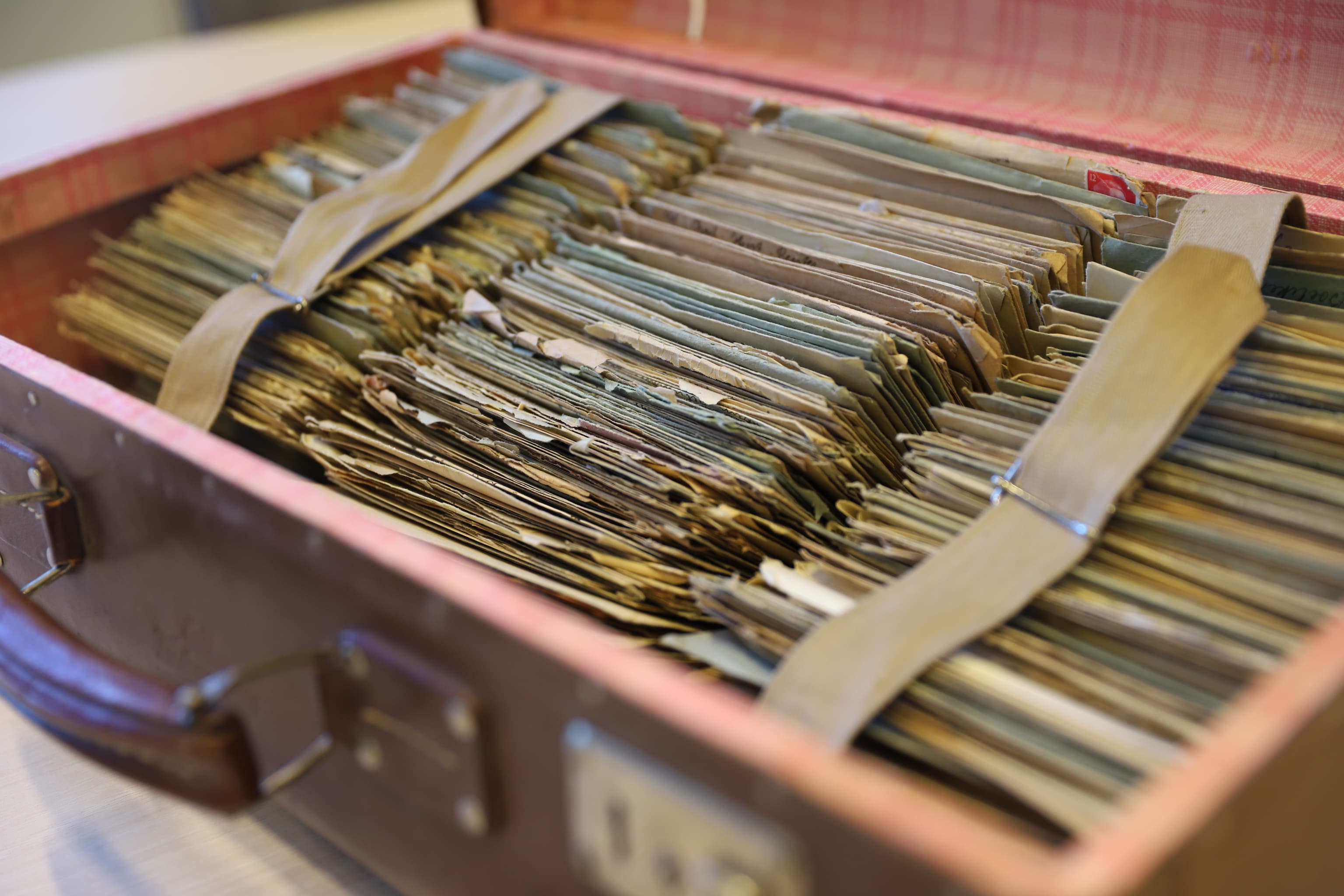
One of the contributions that was sent to the campus was a suitcase containing 2,000 letters from various senders, mainly the Hirt brothers (see Figure 1). Each of these letters had been opened and read, except for one particular letter from November 1943, which was still sealed.
The letters in our possession were written by Jean-Pierre Hirt, born in 1923 in Ettelbrück in the north of Luxembourg. Like many other Luxembourgers during the Second World War, Jean-Pierre was put to work by the Nazis, first through the Reichsarbeitsdienst and later in the Wehrmacht. Together with his older brother Michel (born in 1920), Jean-Pierre trained as a radio and telecommunications specialist in the German air force. The two men, forced to wear German uniform, wrote each other hundreds of letters and postcards, including during their unlawful military service.
The letters from the suitcase (mainly written by Jean-Pierre) bear witness to an extensive correspondence with family and friends across Luxembourg. One such friend was Aloys Michels (born in 1921), also from Ettelbrück. He was called up by the Nazis and deployed to the Eastern Front. While Jean-Pierre and Michel were being trained in radio and telecommunications in Northern Germany, Aloys was fighting in Ukraine as winter set in.
Contact with the home front was facilitated by the German field post, although this was beset with the usual obstacles. First of all, letters had to make it past the strict German censor; Luxembourgian men (and women) had to write in German and could not let anything slip about their position or military activities. Many letters disappeared without trace; parcels of food, warm clothing or luxury items such as razors or soap were stolen in transit. As a result, a large number of letters never reached their destination.
"I see you're still alive"
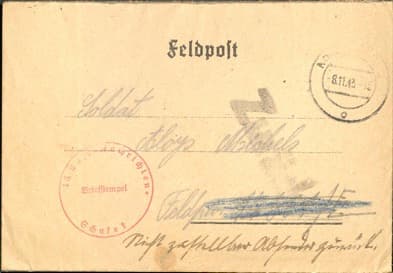
Jean-Pierre and Michel made frequent use of the Feldpost to keep in touch with family and friends. On 7 November 1943, the brothers wrote a letter to their friend from the training centre in Nordhausen. The poignant first line reads: ‘I see you’re still alive and that you’re doing well.’ This sentence immediately reminds us that a war was raging and death was ever-present. Relatives at home would wait anxiously for a reply from their loved ones at the perilous front. In this tragic case, that reply would never come. The letter was returned to the brothers in Nordhausen, the word Zurück (‘return’, see Figure 2) printed on the envelope in bold letters. Aloys had never received or read it.
The last mention of Aloys is found in the grave registration of the Volksbund Deutsche Kriegsgräberfürsorge, the German war graves foundation. He had been reported missing or dead on 1 November 1943, even before Jean-Pierre sent him the letter. Precisely how and where Aloys died is not entirely clear; he either fell into the hands of the Red Army or he was mortally wounded.
This brief moment in the life of a young man during the war was by no means unique; hundreds of others in Luxembourg, and many, many more in Europe, Australia, Japan and the US had similar experiences. Countless letters were returned to sender because the intended recipient had perished. Both of the Hirt brothers survived the war and returned to Ettelbrück. Jean-Pierre probably took the unopened letter back to Luxembourg, where it lay hidden amongst the other letters in the suitcase for decades – until it was discovered and opened by the WARLUX team.
Written by:

Dr. Nina Janz
Subscribe for the newsletter
Stay up to date every month about new publications, activities and more.
NIOD
Herengracht 380
1016 CJ Amsterdam
Visiting hours study room
Tue - Fri: 09:00 - 17:30 hour
Closed on Monday
Note:
The NIOD itself is open as usual on Monday.
Donate archival material to the NIOD?
The NIOD is an institute of the Royal Netherlands Academy of Arts and Sciences