On digitisation and choices
NIOD recently digitised a ‘test batch’ for the project ‘First-Hand Accounts of War: War letters from NIOD (1935-1950) digitised’. In this blog post, project staff Carlijn Keijzer and Annelies van Nispen explain why scanning archival material requires a customised approach, right down to the (lowest) level of the individual page.
11 March 2021
·
by Carlijn Keijzer and Annelies van Nispen
·
6 minutes
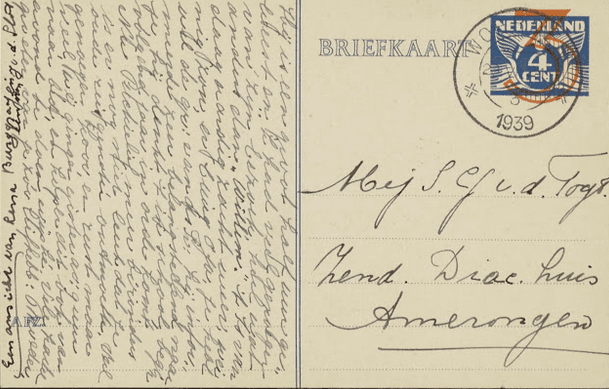
Collectie 247, inventarisnummer 984
Thirteen metres of war letters are being digitised for the project First-Hand Accounts of War: War letters from NIOD (1935-1950) digitised. To prepare for this process, in November 2020 part of the archive was sent to digitisation company GMS as a ‘test batch’.
When compiling the test batch, we selected inventory numbers that are representative of the archive in terms of their nature, particular qualities and/or degree of difficulty. The decisions taken as a result of digitising the test batch will serve as a model for the digitisation of the rest of the archive.
The test batch is back from GMS in the meantime, and the project team has started checking the results. During this control phase, we inspect and assess all of the scans; that is, both the digital master files for long-term storage and the scans derived from these that will be made available to users. When checking, we pay attention to technical aspects, image quality, completeness, types of derivatives, file naming, and whether our scan instructions have been followed correctly. If everything proves to be sufficient, the bulk of the digitisation will go ahead.
Scanning instructions
As we’ve shown in recent blog posts, the Correspondence Collection (247) is extensive and extremely varied. In addition to letters, it also contains postal orders, photos and photo albums, objects (medals, long-play records), passports and identity cards, diaries, agendas, and printed material such as newspaper clippings.
In the preparatory phase, we drew up scanning instructions for every inventory number to ensure that all of the items were scanned correctly. The scanning instructions paid specific attention to photos that are in Melinex sleeves, atypical formats, the scanning order, and the material state of an item (such as fragile pieces, water damage or tears, meaning that these documents need extra care). We thought we’d sketch out some of the challenges here, based on examples from the collection.
Scanning direction
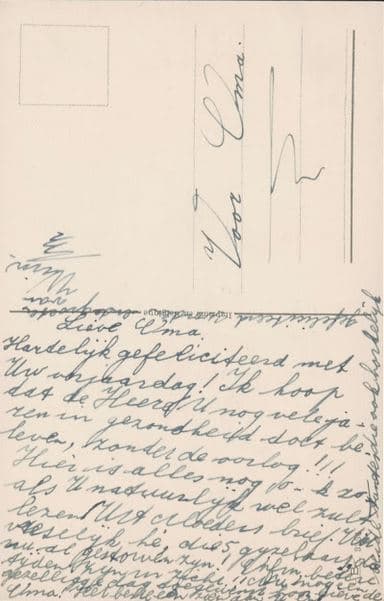
In general, the scan operator should always be instructed to scan documents ‘in the direction of the majority of the text’. Apart from the fact that consistency is always recommended, during the checks we came across two scanning approaches for a postcard in a single inventory number (see figures 1 and 2). Even though ‘the majority of the text’ runs in a vertical direction, we decided to use the scanning approach in Figure 1 as the model for postcards. This approach does the greatest justice to the editorial form of the document, and our viewer makes it possible to rotate the scan.
Scanning order
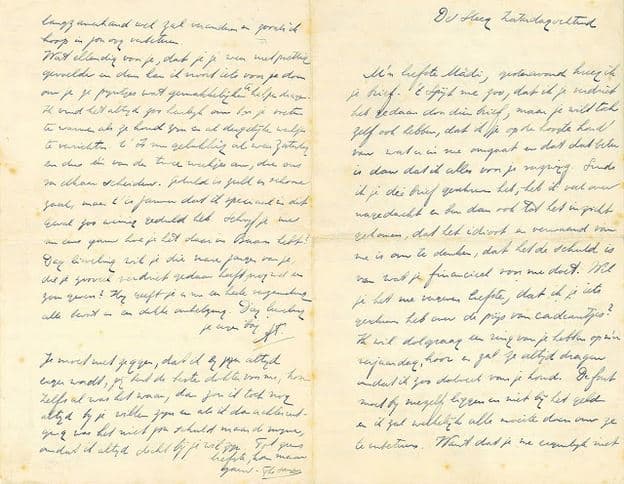
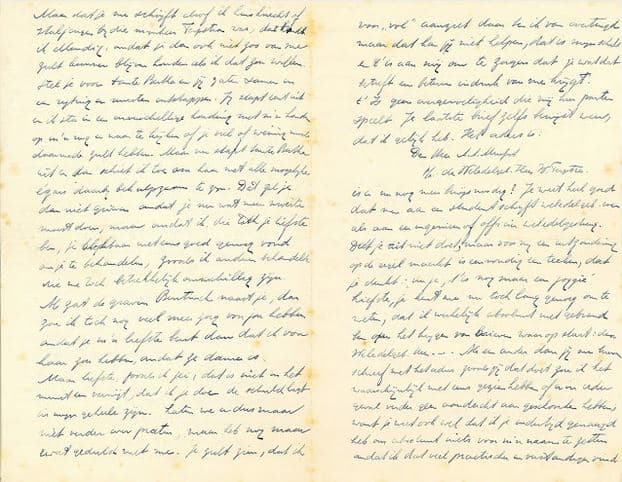
The order in which letters should be scanned is not always obvious. That’s the case, for example, for a letter that Maria Witlam wrote on 24 April 1915 to her nephew Anton Mussert, who was 18 years her junior and whom she would marry two years later. At first glance, it appears to be a standard letter, written on four sides of a sheet of a paper that has been folded once (see figures 3 and 4). However, substantive analysis shows that it needs to be read in an atypical order: from left to right, namely from page 4, via page 1 and page 3 to page 2. To avoid any errors, we instructed the scan operator to make a separate image for each side, and to include a white strip explaining the scan sequence.
Barely legible original = barely legible scan
On the whole, copy paper that has been inscribed with a (light) pencil is difficult to read. Copy paper is very thin, translucent and highly glossy (smooth) paper. Because readability can only be improved to a limited extent – by increasing the contrast in the image, for example – barely legible originals tend to result in barely legible scans. Although you will never end up with better quality than the original, in the case of white or light-coloured copy paper, it pays to choose a white under-sheet. Copy papers in darker colours, meanwhile, often come out better when they are scanned on a black background.
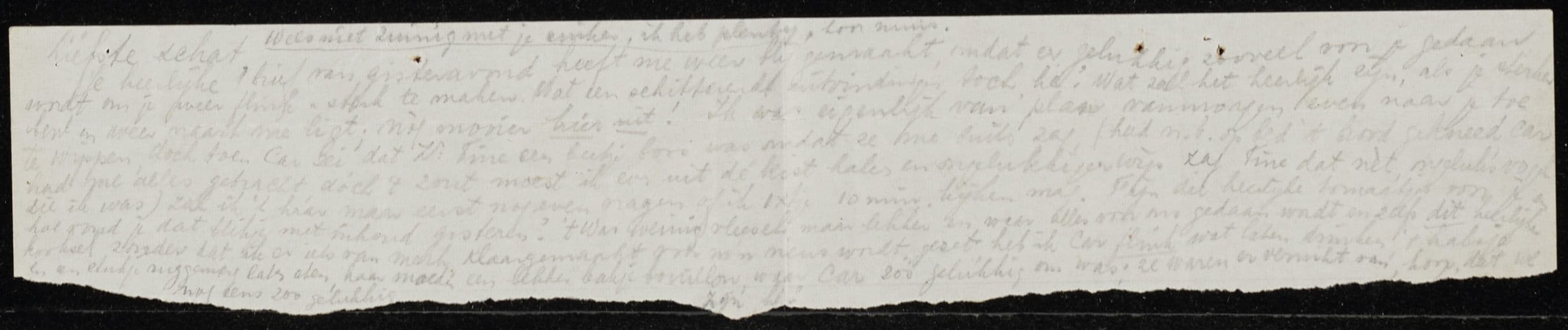
One of our favourite examples is a note written by a prisoner to his wife from the Oranjehotel prison. As he did not have any writing implements, the prisoner scratched his message on the paper with a sharp object. We knew that this letter would be a challenge to scan, and unfortunately this was the best that could be done:
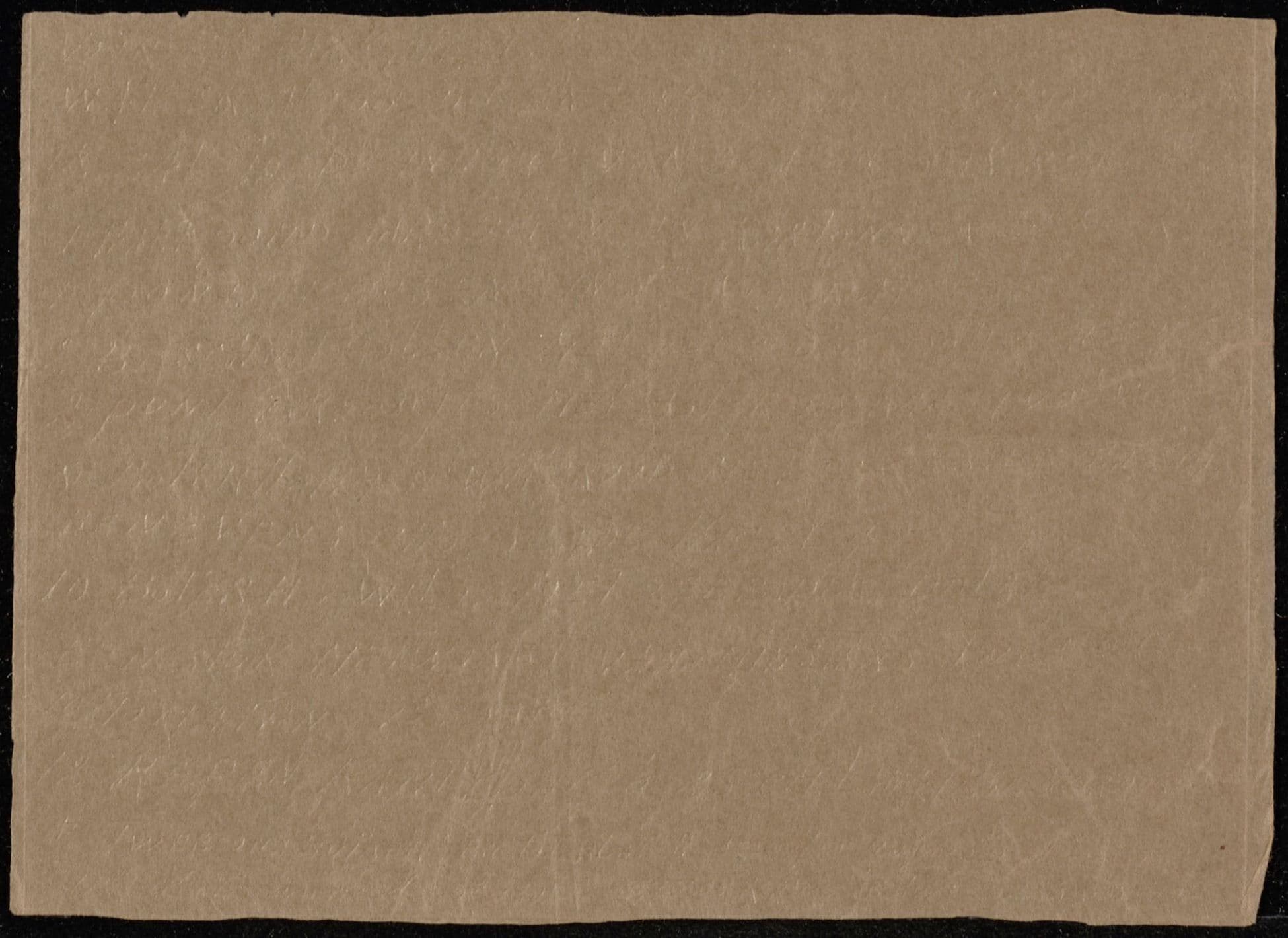
From the examples above, you can see that scanning archival material is customised work, right down the (lowest) level of the individual page. If all of the checks pass, we will be able to make a start on digitising the remaining 13 metres. It’s an exciting time, in other words! We’ll be sure to keep you updated.
Postscript, 24 March 2021
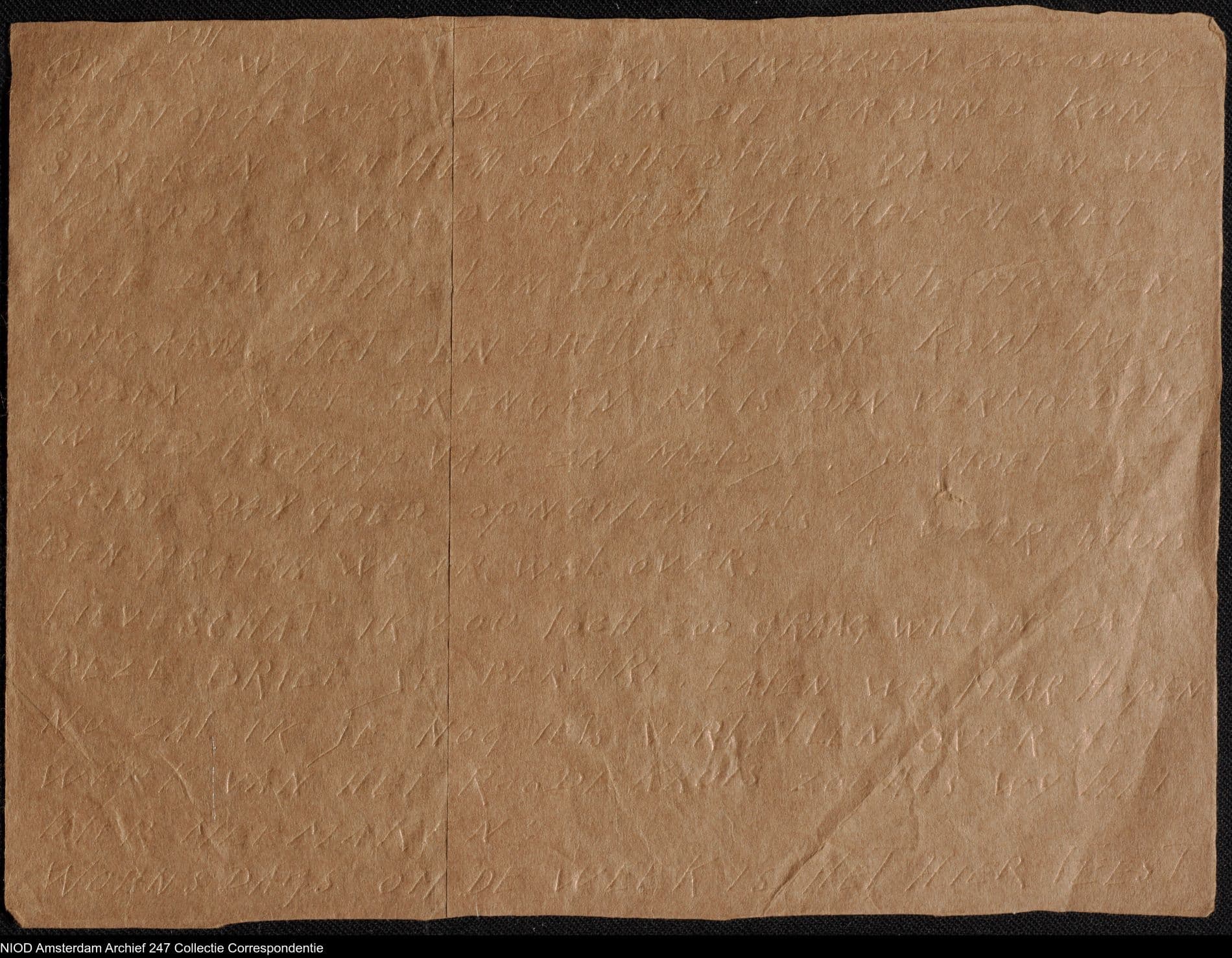
Having experimented with lighting, GMS eventually managed to make the scratched letter readable after all. This came as a wonderful surprise and we look forward to sharing it!
Continuing reading?
- Milan van Lange, ‘Het belang van brieven: De betekenis van digitalisering van de NIOD-oorlogsbrievencollectie voor heden, verleden en toekomst,’ NIOD blog, 9 December 2020.
- Carlijn Keijzer and Annelies van Nispen, ‘“Oorlog uit Eerste Hand”: In het archief met Sergio Leatomu,’ NIOD blog, 9 October 2020.
- Milan van Lange, Annelies van Nispen and Carlijn Keijzer, ‘Even voorstellen: “Oorlog uit Eerste Hand. Oorlogsbrieven (1935-1950) van het NIOD digitaal”,’ NIOD blog, 1 July 2020.
The War Letters project is funded by a grant from the Mondriaan Fund and the Dutch Ministry of Health, Welfare and Sport, as part of ‘75 years of Freedom’.
Subscribe for the newsletter
Stay up to date every month about new publications, activities and more.
NIOD
Herengracht 380
1016 CJ Amsterdam
Visiting hours study room
Tue - Fri: 09:00 - 17:30 hour
Closed on Monday
Note:
The NIOD itself is open as usual on Monday.
Donate archival material to the NIOD?
The NIOD is an institute of the Royal Netherlands Academy of Arts and Sciences