The bombing of Amsterdam-Noord in children’s diaries
“The people here in Amsterdam haven’t experienced anything yet, you can see that when the air-raid siren goes off, because they keep walking along calmly or watch the English planes that draw such pretty lines in the sky”, wrote thirteen-year-old Henk Duijm in his diary on the eve of the bombing of Amsterdam-Noord. He himself was already an expert, because his parental home had been destroyed in the bombing of Rotterdam on 14 May 1940. After moving from place to place, his parents were assigned a house north of the IJ River. Both he and his sister Maria, three years his senior, kept a diary during the occupation.
17 July 2023
·
4 minutes
·
Drs. René Pottkamp
Beeldbank WO2
The bombing of Amsterdam-Noord
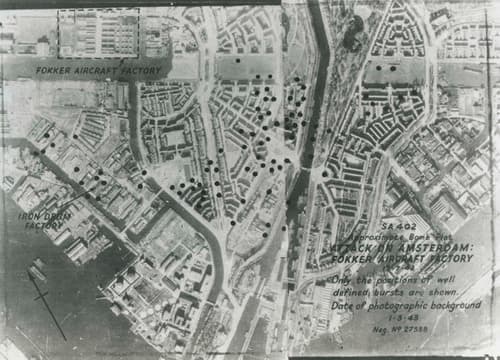
On the morning of 17 July 1943, American bombers carried out an attack on the Fokker factory on Papaverweg in Amsterdam-Noord. The German occupying forces had requisitioned the factory, and were manufacturing war materials there. Due to bad weather, the inexperienced aircrews failed to hit the target. The bombs fell in the middle of the Van der Pekbuurt, Bloembuurt and Vogelbuurt neighbourhoods, killing 185 civilians.
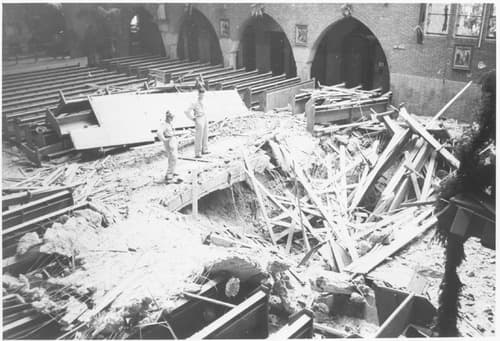
One projectile bore through the roof of the Sint Ritakerk, where hundreds of people had congregated to celebrate the twenty-fifth anniversary of the parish. Fortunately the bomb only exploded deep underground, and the number of fatalities was limited to eleven. In the adjacent Sint Rosaklooster, seven nuns were killed. Further along Meeuwenlaan, the full waiting room of a GP practice was hit, killing 29 people. The police station on Adelaarsweg was destroyed, killing three officers and several detainees.
"The church shakes, the ground trembles"
Henk Duijm was one of the children celebrating the anniversary in the Ritakerk. The air-raid siren sounded towards the end of the mass, and a little later the churchgoers heard loud bangs. In his diary, Henk wrote: “The church shakes, the ground trembles and we hear bombs screeching and crashing and huge explosions. The children are scared and many start to cry. Then I suddenly see the back of the church split in two: chunks of wall fall down and the church suddenly goes dark, all the lights go out and the rubble and dust make everything even darker.”
Henk ended up under a pew and found his way blindly to the exit. In Van der Pekstraat, it was dirty and slippery due to the burst water mains. Bombs had exploded in the public gardens in the middle of the street, “throwing mud against the houses and filling the streets with sludge”.
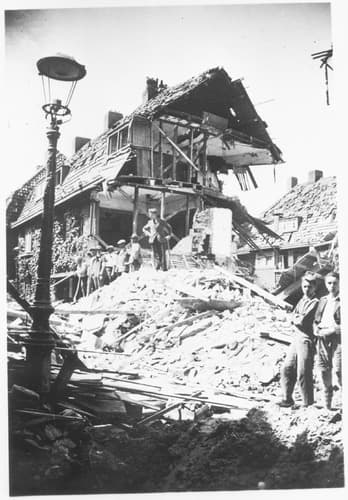
He ran over the shards of broken roof tiles to his house on Sleutelbloemstraat 2. but there he found only a heap of bricks with the roof slanted on top. After a long time and with great difficulty, his mother, sister Maria and little brother Piet were pulled alive from the rubble.
“The floor slid from under our feet"
While Henk was at church, his mother and sister had been cleaning the house. In her diary, Maria wrote that she had jokingly said to her mother, “I’ll stop dusting now, because if a bomb falls I’ll have done it all for nothing.” A moment later, she heard a whizzing sound followed by a loud bang: “The floor slid from under our feet and the three of us tumbled down. As we fell, bricks and pieces of wood pounded on our heads, our backs and everywhere [...] our mouths were full of dust and bits of rubble.” Maria and her little brother Piet found themselves trapped under the bannister. A large chunk of the chimney had come to rest 10 centimetres above her mother’s head. Mother lay on her back with her legs dangling in a hole, her “dark blue raincoat white from the plaster.” After some long, fearful moments, the head of the neighbourhood air-raid defence freed mother, Maria and Piet.
Henk and Maria Duijm’s whole family had been saved, and they were later assigned a house in Amsterdam-Oost.
Continuing reading?
Collection 244 contains diaries and egodocuments
The diaries of Henk and Maria can be found in collection 244, numbers 1808 and 1807, respectively.
NIOD’s image bank includes a series of photos of the damage caused by the bombing raid.
Subscribe for the newsletter
Stay up to date every month about new publications, activities and more.
NIOD
Herengracht 380
1016 CJ Amsterdam
Visiting hours study room
Tue - Fri: 09:00 - 17:30 hour
Closed on Monday
Note:
The NIOD itself is open as usual on Monday.
Donate archival material to the NIOD?
The NIOD is an institute of the Royal Netherlands Academy of Arts and Sciences