Between war vengeance and the rule of law
The Special Jurisdiction after the Second World War
Even before the German occupation ended, the Dutch government decided to establish a Special Jurisdiction to punish collaborators. After the liberation, however, the desire to restore the constitutional state in the Netherlands appeared to be at odds with feelings of war vengeance.
24 April 2026
·
Longread
·
50 minutes
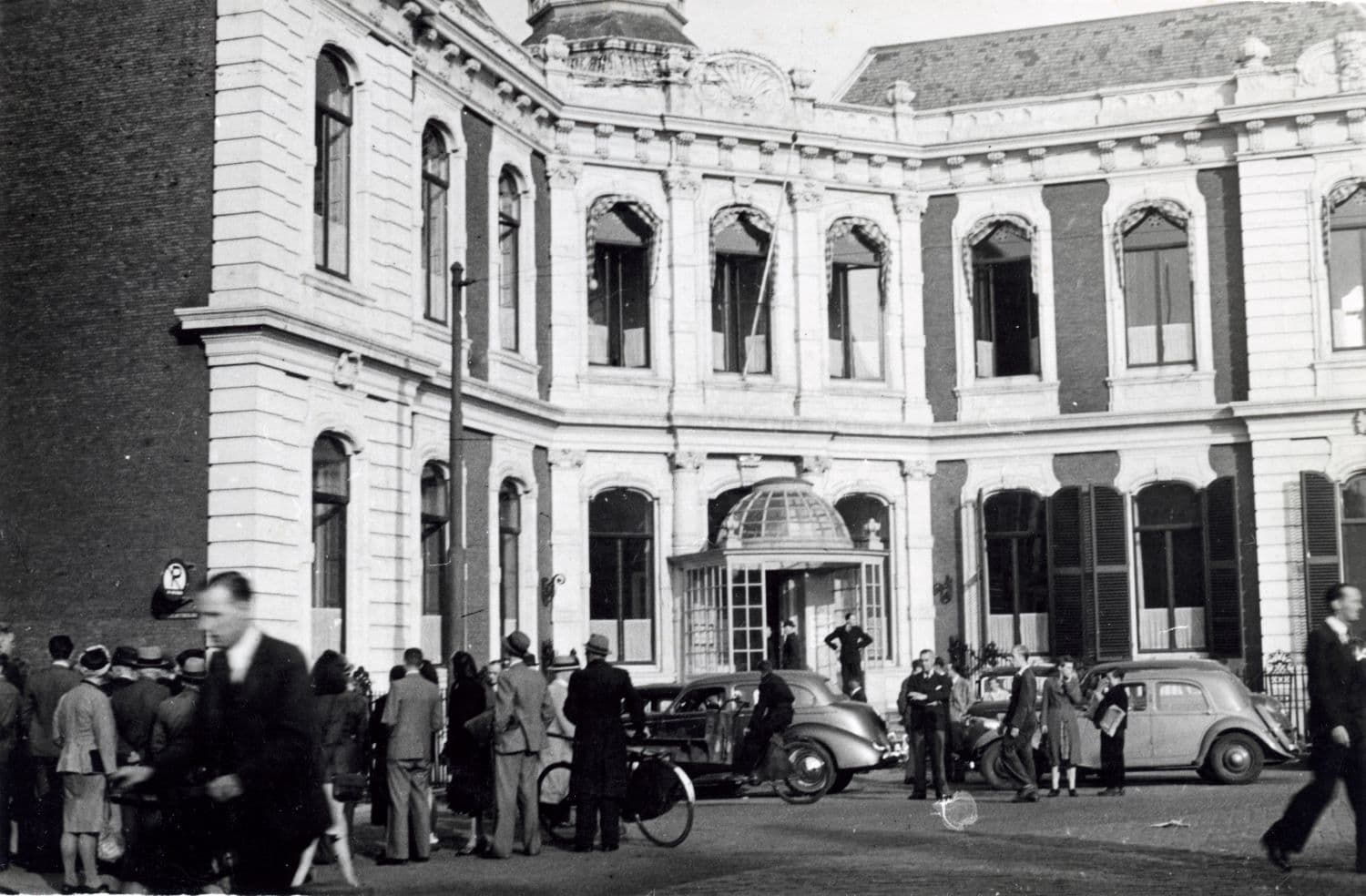
On Tuesday 21 August 1945, it was drizzling incessantly in the centre of The Hague. The summer was drawing to a close, and in the grand quarter of the city around Noordeinde Palace and the Binnenhof, many of the government buildings had regained their former function after five years of occupation by the German forces. At the Ministry of Justice building on the corner of Plein and Lange Poten, the Cabinet had started meeting again at the end of May. Not far away at Noordeinde Palace, Queen Wilhelmina had returned at the beginning of the summer, in a ceremony full of flags and saluting soldiers.
However festive the government’s return from its London exile may have been, it did not herald the automatic restoration of the old order in the Netherlands. The war had created a deep rift between the pre-1940 world and the world that had emerged in 1945. The question was whether a complete return to the old, pre-war order was even possible. How could the people continue after everything that had happened during the war? How could there be a reckoning with the horrors, the full nature of which had yet to sink in?
These questions would continue to resonate for decades to come. On that rainy morning of 21 August, however, a start was made on finding an answer. In the place where this would happen, in the centre of The Hague, a group of about a hundred journalists and other interested parties had gathered. They stood in front of the entrance to one of the imposing buildings in the old government quarter, Kneuterdijk Palace, with its white, neo-classical facade curving around Kneuterdijk towards Lange Voorhout. Once upon a time, this had been the palace of crown princes Willem II and Willem III, but during the occupation it had been requisitioned by the Nazi government and transformed into the Ministry of Public Information and the Arts. But now, after the liberation, the palace had a new purpose: to host the trials of war criminals and collaborators from the Second World War, Nazi bigwigs such as NSB leader Mussert and SS commander Hanns Rauter, members of the Waffen SS, the WA and the Landwacht, but also civilians who had deliberately endangered their fellow citizens during the occupation.
The government decided that the punishment of these various groups required a different kind of trial from that offered by the standard pre-war jurisdiction. To start with, much harsher penalties were introduced, in the most extreme case the death penalty, which was re-introduced specially for the Special Jurisdiction. Under the Special Jurisdiction, for example, membership of the Waffen SS, defined as entering into the service of an enemy power and normally subject to a maximum penalty of fifteen years’ imprisonment, was punishable by death. Prior to the war, belonging to the NSB had not been a criminal offence, but now after the liberation it was retroactively defined as aiding the enemy. New penalties were also introduced, for betraying and harming fellow citizens with the help of the enemy occupying forces.

The first session
The decision to establish a Special Jurisdiction had been taken by the Dutch government during the occupation. The swift and severe prosecution of all those who had supported the Nazi regime, in whatever way, was not only the right thing to do morally, but it was also essential from a social perspective, so that post-war Dutch society would be able to heal and move forward. Moreover, the government was afraid that if it failed to punish collaborators swiftly and severely, it was highly likely that citizens would take justice into their own hands.
For that latter reason alone, it was intended that the Special Courts would start operating in five cities as soon as possible after the liberation: Den Bosch, Amsterdam, Arnhem, Leeuwarden, and of course The Hague, the seat of government. In practice, however, this tight schedule proved impossible. Almost everything was in short supply: workspaces, personnel, paper and other supplies for building files and, last but not least, judges who had not been overly accommodating to the wishes of the Nazi authorities during the occupation.
And thus, it was already three and a half months after the liberation of the Northern Netherlands when the first sessions of a Special Court were held: on 21 August in the ballroom of Kneuterdijk Palace in The Hague, converted into a courtroom for the occasion.
The interested parties who were waiting in the rain had not come for the prosecution of notorious defendants; none of the Nazi leaders would be brought to trial any time soon. The trial of NSB leader Anton Mussert was not scheduled until 13 November – and it would be postponed for yet another two weeks when Mussert’s lawyer suddenly died in October. The trial of SS commander Hanns Rauter would not be held until April 1948.
The Anton Mussert case
The trial of NSB leader Anton Mussert took place on 27 and 28 November 1945 at Kneuterdijk Palace in The Hague, and lasted two days. After the statement by the defence lawyer, Mussert himself was given the floor. On 12 December, the Special Court delivered its verdict, sentencing Mussert to death.
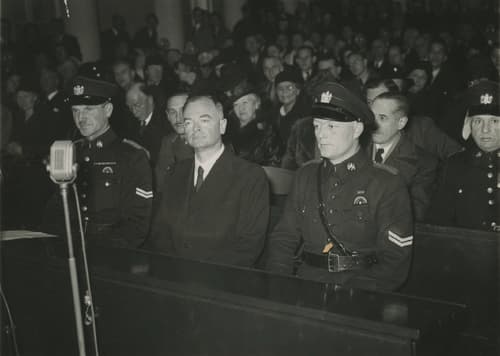
At the first session in The Hague, many smaller cases had been on the agenda that required less time to prepare: a hard-up labourer from Berkel who had worked for the German army out of financial need, a factory worker who had denounced colleagues for distributing resistance pamphlets, a gardener who had reported his neighbour for listening to English radio broadcasts, a manufacturer of building materials who had joined the Landwacht (a pro-German paramilitary organisation), a policeman from Katwijk who had shot a resistance fighter during a raid on a distribution centre, an unemployed dairy farmer from Delft who had allowed people to hide in his house and then reported them to the police, and a man who had accidentally let slip, in conversation with an old friend, the name of someone carrying illegal papers.
The fact that it was these kinds of unknown, often insignificant cases that were the first to be heard gave rise to growing frustration and concern. From the summer of 1945, several newspapers warned that notorious war criminals should be tried first. Otherwise there was a danger that with the passing of time, and the associated waning of public interest, the most serious cases might be punished more leniently. ‘Slow justice does no justice!’ warned Trouw. Het Parool proposed that the most serious offenders ‘be hanged or shot’ as quickly as possible after a summary trial, and that ‘all NSB members’ should be banished to New Guinea, so that the entire Special Jurisdiction could be concluded within six months. If things continued as they were, with the ‘lengthy and time-consuming procedure’ currently used to prepare the cases, ‘under the motto that we must remain a constitutional state’, it would certainly take another five years for all of the cases to be resolved.
It was generally true that the bigger the case, the longer the preparation. As with the regular administration of justice, in the Special Jurisdiction charges were handled by the public prosecution service, which had far too little capacity to process the hundreds of thousands of cases of suspected collaborators in a timely manner, even with the special support of investigative services composed partly of resistance groups. The public prosecutor, known in the Special Jurisdiction as the procurator fiscal, was granted more and more powers as a result of these capacity-related problems. What remained the same as in regular legal proceedings was that the procurator fiscal, acting on behalf of the Ministry of Justice, brought charges against the defendant, which were then assessed by an independent court.
And so it happened on 21 August. When the doors of Kneuterdijk Palace opened just before ten o’clock, the spectators were led to the Old Ballroom, located at the very back of the building. Designed to impress, with its gently domed ceiling decorated with arabesques, and a white marble colonnade on either side, the hall was reminiscent of the palaces of the tsar in St Petersburg – not coincidentally, as this part of the palace had been built for Willem II, who had married Anna Paulowna, daughter of Tsar Paul I of Russia.
Upon entering the hall, the public saw a table before the back wall, shaped like an elongated semi-circle and spanning the entire width of the room. That was where the judges would sit, facing the defendants and the public. Between the white pillars on either side of the hall were closely-spaced rows of wooden benches, with just enough space for people’s legs. These were packed with spectators, with no room to spare.
On the strike of ten, the court rose en masse as the judges entered: three clad in robes, two in military uniform. This had been the idea of the government in exile: to emphasise the extraordinary nature of the Special Courts, the judges should include three jurists and two military personnel. This corresponded to the emergency powers on which the Special Jurisdiction was based; in the event of war, exceptions could be made to existing legislation for reasons of state security, fundamental rights could be suspended, and the death penalty could be imposed. During the liberation of the southern provinces in the autumn of 1944, there was every reason to invoke these emergency powers; at that time, the front line of the war crossed the Netherlands and remained there for more than six months. If thousands of Nazi supporters had been allowed to roam freely behind that line in liberated territory, this could have posed a concrete threat to the advance of the Allied army.
The question that was already being raised at the time in some media was whether arrests were not being carried out too lightly, given the rapidly increasing numbers in the detention camps, and to what extent this involved not only military necessity but also a desire for revenge. In May 1945, during the liberation of the north, those same questions were raised again—this time more critically, as people had by then come to understand the uncontrollable conditions that the mass detentions in the south had led to. Nevertheless, the liberation of the northern Netherlands was also accompanied by a wave of arrests involving many tens of thousands of collaborators. Only now the war was over, and it was no longer easy to invoke military necessity as a justification for the arrests, or to claim that the detainees posed a threat to the survival of the state.
The defendants who were led into the ballroom of Kneuterdijk Palace on 21 August did not look very menacing, in any case. The reporter from de Volkskrant watched the eight cowed men take their place in the dock, where they would wait all day to find out which penalty was demanded for them. ‘Small men, small cases’, was how he summarised the first day of the hearing. Normally this would be reflected in the sentencing demands, but today was very different: ‘Upon the establishment of this court, the procurator fiscal, Hans Zaaijer, argued strongly and emphatically that the Dutch people would present its bill to those to be brought before them.’
These words, paraphrased in the Volkskrant report, had indeed been spoken in the same courtroom by procurator fiscal Zaaijer three weeks earlier, on 4 August, and they had made a great impression. They were reported by various newspapers, Het Parool quoting Zaaijer verbatim: ‘The bill will be presented mercilessly, if we are given the opportunity. (...) Once a guilty verdict has been reached, it will no longer be a question of which punishment is most suitable for the guilty party, but how high a bill must be settled with the Dutch people; and the guilty will have to pay in full, preferably more rather than less.’
Much attention at this first session of the Special Court in The Hague was thus focused on the procurator fiscal; now it would become clear how the ‘merciless bill’ of which he had spoken would be translated into concrete sentencing demands. No one doubted that they would be significant; the question was whether the harshest demand, the death penalty, would be among them. And thus Zaaijer’s omonious announcement, made three weeks previously, reverberated in every new case he handled that day, such as when he turned to address the man who had joined the Landwacht. ‘A hyena institution’, was how he described it; a hyena institution made up of traitors who were too cowardly to fight for the Germans at the front. They preferred to stay safely in the Netherlands to ‘hunt civilians. (...) The members of this organisation, every last one of them, with very few exceptions, deserve death.’
Not long afterwards, Zaaijer turned to the dairy farmer who had betrayed the couple hiding in his home: according to the procurator fiscal, he was guilty of ‘dirty treachery’, with the consequence that ‘several people had been sent to their deaths’. The people hiding in Breedveld’s house, the Van der Veens of Rotterdam, had been deported to Westerbork after their arrest, and from there to Auschwitz, where they were murdered on 7 December 1942.
After Zaaijer had listed the charges against the defendant in each case, he presented his sentence demands: five years for the man who had betrayed his neighbour for listening to English radio broadcasts, eight years for the factory worker who had reported two colleagues distributing illegal pamphlets. Each was addressed in turn, until he came to the member of the Landwacht and the dairy farmer from Delft. For the former, Zaaijer demanded the death penalty.
His words sounded loud in the tense silence that hung in the hall, observed the journalist from de Volkskrant. The reporter from De Tijd was also struck by the momentousness of the occasion, and noted the exact time when the procurator fiscal had first demanded the death penalty: twelve to eleven in the morning.
The first death sentence
Two weeks later, the Special Court reconvened to deliver its verdict: the judges granted the requested penalty for most cases, or ordered an additional investigation. Only the man who had accidentally revealed the name of an acquaintance was acquitted. The member of the Landwacht, whom Zaaijer had addressed so harshly, also received a milder sentence than that demanded by the procurator fiscal: twenty years in prison and life-long disenfranchisement.
But in the case of the unemployed dairy farmer from Delft, who had betrayed Jews in hiding to the police, the Court decided to impose the death penalty. And thus all of the newspapers published in bold the name of Jacobus Breedveld, the first person to be sentenced to death by the Special Jurisdiction. ‘The first death sentence. After 75 years’, ran the headline in De Maasbode on 5 September 1945, referring to the period when the death penalty had been abolished in the Netherlands. De Volkskrant also emphasised that this was an historic moment: ‘With this, the death penalty, which has been absent from our civil criminal law for 75 years, has again become a reality.’
That the person at the centre of this historic moment was hardly a charismatic figure proved to be rather an anti-climax. Jacob Breedveld was a man without convictions – something that had become clear during the hearings, and during previous interrogations and testimony. He had not been a member of the NSB or any other Nazi organisation, he had never even been a Nazi sympathiser. According to Breedveld’s own statement, he had only subscribed to Volk en Vaderland (a pro-Nazi weekly) because it was the cheapest way to light his stove – for he wasn’t able to read, as all the witnesses confirmed. During his interrogation, Breedveld had stated, seemingly without qualms, that he had taken in the Jewish couple for opportunistic reasons, because he had been promised that he would earn some extra money by doing so. When their presence had begun to irritate him after a few days, he had reported them to a detective from the political police.
The small-minded, almost banal egoism of this man, who seemed barely aware of the effect his actions had on others, paled in comparison to the gravity of this historic moment, noted several journalists in the courtroom. Breedveld had sat there expressionlessly, almost indifferently, and had shown no reaction at all when the death penalty was demanded. Was this a case of complete moral desensitisation, or was he mentally unstable, as Breedveld’s lawyer claimed?
After the news of the first death sentence broke, surprisingly little was said about the person of Jacobus Breedveld. Perhaps the newspaper editors found him too uninteresting to cover, perhaps it was because his case was too difficult to reconcile with the existing stereotypes of the fanatical Nazi supporter, the ‘NSB member on the wrong side’, the fearsome traitor. The vast majority of reports focused on the fact of the death penalty itself: ‘This verdict is indisputably of historic significance’, wrote de Maasbode the day after Breedveld’s conviction: ‘with this sentence, “the spell has been broken”, (....) Because this sentence will generally satisfy the great masses’ instinct for justice.’ The event transported the Nieuwe Haagsche Courant back to Old Testament times: ‘Whoever deliberately sheds the blood of man, his blood shall be shed by the worldly sword of justice after due process,’ noting that the reintroduction of the ‘ultimate sanction’ corresponded to the ‘general sense of justice’.
Phrases like the ‘general sense of justice’ or ‘the masses’ instinct for justice’ or the ‘people’s feeling for justice’ often appeared in newspaper articles about the Special Jurisdiction, in particular about the reintroduction of the death penalty. ‘The public expects’, declared Trouw on 29 May, ‘the restoration of legal certainty and satisfaction of a wounded sense of justice.’
This was a difficult, if not an impossible, combination: on the one hand the restoration of the rule of law, on the other hand vengeance for the wartime suffering inflicted on the people by the enemy, which in fact necessitated the temporary suspension of a number of suspects’ basic rights, by detaining tens of thousands of them in internment camps without a court order, or by criminalising them for actions that had not been punishable offences at the time they were committed.
In a radio address on 18 August 1945, the newly appointed prime minister Wim Schermerhorn announced that the Special Jurisdiction would herald the restoration of the democratic rule of law, ‘so that our country can return to its former legal certainty [rechtszekerheid]’. But in the same speech, Schermerhorn promised that the collaborators would ‘be held jointly responsible for all crimes committed by the occupying forces’; a verdict that was difficult to reconcile with the same principle of legal certainty, which should guarantee that every individual case is weighed by a judge, and prevent citizens from being held collectively responsible for a foreign occupying regime.
This ambivalence in the prime minister’s address was symptomatic of the dilemma facing the returning government, between war vengeance and the restoration of justice; two roles that, viewed with hindsight, were in tension with one another. Yet, shortly after the liberation, a large part of the population perceived them as anything but contradictory.
Indeed, the great majority of the Dutch people saw tough treatment of collaborators as a prerequisite for the restoration of the rule of law. And if the government were half-hearted in its response, the latter had feared during its exile in London, citizens would take the law into their own hands.

Day of reckoning
‘Bijltjesdag’, the day of reckoning: the word had been in use since the first years of the war to describe the scenario of the masses seeking justice. This had convinced the exiled government in London in 1942 that the restoration of authority after the liberation required a swift and severe judicial procedure. For almost two years, the ministerial team worked on the regulations governing the Special Courts and the arrest and detention of collaborators and war criminals. On 22 December 1943 they were signed by the Queen, whereby they were granted the status of Royal Decrees, not legislation; the latter would have required approval by parliament and the Senate. And that was impossible; parliament had not fled to London, and had been dissolved by the Germans during the occupation.
In addition to the Royal Decrees that formed the basis for the Special Jurisdiction, in the final year of the occupation another Royal Decree was added, applying to what was perhaps the largest category of collaborators: Dutch citizens who had joined the NSB or another civilian National Socialist organisation, but who had done nothing else to aid the occupying forces or endanger their fellow Dutch citizens in any way. The punishment of this category of citizens was legally tricky, because it could only be justified on the grounds of political inclination. When it came to this group, the government decided to apply a completely different form of law: disciplinary law. Separate tribunals for this purpose were established in addition to the Special Jurisdiction, on which laymen sat as well as lawyers, and that could sentence the accused to a standard prison term of up to ten years, remove their active and passive voting rights, and confiscate their assets.
This Tribunal Decree, like the decrees on the Special Courts, disregarded the Dutch Constitution and legal system on several points. It was at odds with the Constitution, for example, by declaring a person’s assets forfeit as a punitive measure. The lack of a public prosecutor at the tribunals was also problematic: the tens of thousands of NSB members and other suspects who were arrested during and immediately after the liberation would be prosecuted on the basis of complaints made by private citizens, and tried by tribunals that were partly composed of laymen – and the convicted would have no possibility of appeal. The only check that was built in to ensure due process lay in the fact that every tribunal decision had to be approved by a specially appointed ‘High Authority’.
The announcement of the Tribunal Decree in September 1944 immediately provoked fierce criticism, including from some resistance newspapers, which had tended to be quite positive in their commentary, not least when it came to the prosecution of collaborators. But Trouw strongly opposed the ‘lay justice’ of the tribunals, because the paper believed it to be in conflict with the Constitution, and more akin to the ‘day of reckoning’-type popular courts that the government claimed to be so keen to prevent. ‘We do not believe that true justice can be achieved this way. Indeed, we see in the proposed measures a kind of government-channelled popular anger that is at odds with the best legal tradition of our people. We therefore believe that the tribunal decree should be withdrawn as a matter of urgency.’
The government responded to such objections with the argument that this concerned disciplinary law, not criminal law, and was therefore not ‘lay justice’. On the whole, disciplinary law concerned the measures that colleagues working in a certain field, such as medicine, could impose on one another for the purposes of re-education and reintegration. But in the case of the Tribunal Decree, that argument was hard to maintain if one considered the punitive sanctions that the tribunals were expected to impose: membership of the NSB alone initially carried a standard prison sentence of ten years (it soon happened that tribunals were allowed to vary the penalty).
At the opening of the first tribunal in Den Bosch, on 25 January 1945, Justice Minister Gerrit-Jan van Heuven Goedhart felt compelled to defend the Tribunal Decree, and in so doing voiced a very practical argument: it was simply not feasible to bring every individual case before a Special Court. ‘Do you now wish the law to define all these behaviours, broken down into their elements, and determine a separate penalty for each? (...) That would require an endless, nay impossible, description of every conceivable form of support for the enemy, profiting from the enemy, propagating National Socialism, undermining the national cause. What is the alternative? The alternative is that all of these enemies of the people, all of these accomplices, all these henchmen of Hitler and Mussert, are allowed to go free, unless they can be brought under the precise descriptions referred to in the Special Criminal Law Decree. No one could want that.’
Even aside from the question of the applicability of the emergency powers, aspects of the Special Jurisdiction were also at odds with important constitutional-legal principles. The most fundamental of these was the retroactive criminalisation of certain acts, a violation of the so-called legality principle set out in Article 1 of the Criminal Code: citizens could not be prosecuted for an act that was not a criminal offence at the time it was committed.
And thus, during the first session of the Special Court in The Hague, it immediately became a legal issue as to whether the man who had joined the Landswacht could have known that he was thereby entering ‘enemy military service’. According to his advocate, he could not. And the same objection could be made in the other cases: could the labourer from Berkel have known that accepting work from the German Army was defined as a criminal offence, even if the work did not serve a military purpose? And what about the policeman from Katwijk, who had shot one of the robbers during an armed raid on a distribution centre by an underground resistance group? Had he been aiding the German enemy, or had he simply been carrying out his duties as a policeman?
And then there was another fundamental constitutional question, one that was raised during the sessions of the Special Court in The Hague by a lawyer for one of the defendants: what was the legal status now, months after the liberation, of the Royal Decrees on which the Special Jurisdiction was based? Was there still a state of war in August 1945, on which the provisions of the emergency law could be based? Had the time not come to reinstate the constitutional provision, namely that a government proposal can only become law if it has been approved by parliament?
The return of parliament
Everyone accepted that the government had been unable to submit its decisions to the House of Representatives during the years of occupation. By now, however, more and more parties were expressing concern that parliament had yet to be convened, despite the entire country having been liberated for months. A new Cabinet had been appointed by the Queen, led by Prime Minister Schermerhorn. Because this new Cabinet, like the previous war cabinets, had been appointed by the Queen due to the exceptional circumstances, it was known as an ‘emergency Cabinet’. Immediately after taking office, however, it appeared that the prime minister and his ministers saw no reason to bring an end to the state of emergency as quickly as possible, and return primacy of power to parliament.
Remarkably enough, it was an innovative, breakthrough idea that led the emergency Cabinet to adopt an authoritarian style of government. The fear of a return to old political divisions and socially stratified power structures (‘pillarisation’) left the new government wary of too swift a restoration of democratic participation. In his first speech as prime minister, Schermerhorn warned that the people were far from ready for elections. It could easily take another year: ‘The people should also be given the opportunity to form their own ideas on the issues that now define the political dividing lines.’
The Cabinet also questioned whether the old House of Representatives, in its pre-war composition, should resume its task of representing the people; for it could hardly be described as representative any more, argued the prime minister and his ministers. On the same day that the Special Court in The Hague held its first session, Minister of the Interior Louis Beel gave an interview in which he was asked whether the government was not violating the Constitution by postponing elections and governing without parliamentary oversight in the meantime. Beel answered: ‘The constitution was written in a different time against a very different background.’
It was this statement by Minister Beel, and the general attitude of the whole emergency Cabinet, that caused great indignation among some of the old democratic parties. Behind the scenes, supported by several major newspapers, they started to exert more and more pressure that it really was time to restore parliamentary democracy.
And thus the members of the Dutch parliament finally assembled at the Binnenhof on 25 September, after five and a half years of enforced absence. Their return was anything but festive, observed the Volkskrant. There were too many empty spaces on the benches for that; belonging to MPs who had died in concentration camps during the war, such as social democrat (SDAP) Alida de Jong MP and liberal (VDB) Mozes Meijer Cohen MP, both of Jewish origin, or from illness or old age. And then there were the empty benches of the NSB faction, whom no one could now imagine ever having sat legitimately in parliament.
But there was yet another reason why the mood was rather sombre: many of the MPs were upset at the way in which the government had treated parliament, by waiting so long to convene it and by denying it its full powers, on the pretext that it was not representative enough to serve as a fully-fledged democratic body. At the second session of parliament on 9 October, the leader of the Anti-Revolutionary Party, Jan Schouten, spoke of a ‘constitutionally unprecedented situation’, one ‘not seen anywhere else in the world’. ‘In my opinion, this proves more than anything else that the government has done nothing to restore the principles of the constitutional state, to restore law and order, to restore the States General.’
The leader of the Roman Catholic State Party faction, Laurent Deckers, also protested loudly against what he saw as the blunt disregard for parliament: ‘In my opinion, it is impermissible to deny the people’s representatives their constitutional powers by invoking the emergency powers act. There is no state of emergency that makes it impossible for parliament to ask questions, oversee, or investigate.’
The issue that was raised at this first meeting of parliament was essentially the same constitutional issue that had dogged the Special Jurisdiction: months after the liberation, could a state of emergency resulting from the war still be invoked? Moreover, now that parliament had convened again, albeit with only limited powers, the question automatically arose as to whether the decisions that the government had taken during and immediately after the years of occupation without parliamentary ratification, including the Royal Decrees that lay at the basis of the Special Jurisdiction, should now be ratified if they were to remain legally valid.
It would be months before the House of Representatives could devote itself to this question of principle, but greater clarity was needed as a matter of urgency. Doubts about the legality of the Special Jurisdiction were considered undesirable by all parties involved, given that more than 150,000 arrested NSB members and other suspects had been waiting in internment camps for months for their cases to be processed.
The legality of the death penalty
And so it happened that Jacobus Breedveld, the unemployed dairy farmer from Delft, who out of petty egoism had reported the Jews hiding in his house – a man who, according to his lawyer, lacked the mental capacity to grasp the full consequences of his actions – became the subject of one of the most fundamental debates in Dutch legal history, simply because he was the first Dutch citizen to be sentenced to death since 1870.
As luck would have it, Breedveld, while undoubtedly unaware of the fact, was assigned one of the most talented and conscientious jurists in the Netherlands as his lawyer: Eduard Droogleever Fortuijn, who would become the state attorney of the Netherlands twenty years later. Droogleever Fortuijn at once understood that the question of the legality of the Special Court contained a crucial element for the defence of his client. Immediately after Breedveld was sentenced to death, Droogleever Fortuijn filed an appeal with the Special Council of Cassation. That step was by no means an option for every condemned person: to promote the rapidity of the Special Jurisdiction, the government had determined that no appeals would be possible against the sentences of the Special Courts, and cassation was only possible if a Special Court gave its permission. It could thus happen, and did indeed happen in a number of cases, that people were condemned to death without having had a chance to appeal against their sentence.
When it came to Jacobus Breedveld, the Special Court in The Hague decided to give Droogleever Fortuijn the opportunity to take the case to appeal. After all, this was the first death sentence in the Special Jurisdiction, and would have significant implications for case law. At 10 o’ clock on 17 October, the Special Court of Cassation met in the building of the Supreme Court, located on the same square by Lange Poten street where the Ministry of Justice was also based.
The Special Court of Cassation was composed of the most senior members of the Dutch legal, administrative and military world (two of the five members of the Special Court of Cassation also had to come from the military). It was chaired by H. Haga, one of the judges who had refused to cooperate on the Nazification of the law during the occupation, and had resigned. Another member of the court was retired General Henri Winkelman, the former commander-in-chief of the Netherlands army, who had signed the surrender of the Netherlands to Germany on 15 May, and spent the years of occupation in captivity.
Similar to the hearings of the Special Court, Jacobus Breedveld was also expected to attend. He was transferred from prison in Scheveningen for the occasion, where he had been under lock and key since his arrest in May. It is doubtful whether he fully understood what was said in the stately hall of the courthouse: the rather formal cassation hearing in the hall of the Justice building dealt with complex legal theoretical-problems that any non-lawyer would find difficult to follow.
Breedveld’s lawyer Droogleever Fortuijn opened his defence with the principled question of whether his client’s death sentence was in fact founded in law. As a rule, a government proposal without the approval of parliament had no legal power. In this case, of course, there had been exceptional circumstances during the occupation, meaning that the government had invoked emergency powers. But now it was the task of the judiciary to consider, for each decision, whether the emergency powers had been used correctly. For example, the decision to introduce penalties into the Special Jurisdiction and to apply these retrospectively should only be allowed, argued Droogleever Fortuijn, in very exceptional circumstances, ‘when the security of the State required it’.
The same applied to the death penalty: only if the state’s continued existence were under threat should it be used in accordance with the emergency powers. And Droogleever Fortuijn thereby came to the heart of his client’s case; for was it not difficult to claim, looking at Jacobus Breedveld, that this man posed a threat to the Dutch state? Could it perhaps be, continued Droogleever Fortuijn, that the real reason why the government wanted to introduce the death penalty had nothing to do with the provisions of the emergency law? Was there not another motive at play, one that could be better described as an ‘emotional reaction’? ‘People felt that the existing penalties were too mild and they wanted to override the objection that the law did not provide the penalties that the people desired. But those were emotional reactions in turbulent times, not the considerations of a sense of justice [rechtsbewustzijn].’
And it was certainly true that the majority of the Dutch population desired much tougher punishments for collaborators than were available under regular law – including the death penalty. In the autumn of 1945, an opinion poll showed that 76% of men, 69% of women, 77% of young adults (aged between 18 and 24) and 68% of people over 55 were in favour of the reintroduction of the death penalty.
Such figures were to be expected. After all, war always gives rise to intense emotions, and the latter can even be useful in life-and-death situations, analysed Droogleever Fortuijn: ‘In battle, killing is a necessity that arises from the need for self-preservation. One’s opponent has to be killed because otherwise one will be killed oneself.’ But in a constitutional state, a strict distinction should be made between military necessity and the administration of justice, argued the lawyer; and it was precisely this distinction that had been undone in the Special Jurisdiction by the reintroduction of the death penalty: ‘And so the demand to kill is transferred from the battlefield (where it belongs) to the courtroom, where it does not. (...) For let us not forget: the death penalty was applied here with retroactive effect. There has been a double breach of the fundamental principles of our criminal law, the combination of which is therefore doubly serious. (...) And the absolute necessity of doing this by emergency decree did not exist.
Between war vengeance and the rule of law
The internal tension between war vengeance and the restoration of the rule of law, which had been present in the Special Jurisdiction from the outset, was precisely captured by Droogleever Fortuijn’s plea. He had raised the question of how far the element of retribution, something that is normally present in law in a controlled form, had been replaced in the Special Jurisdiction by an emotional desire for revenge that was widely felt by the population.
As a rule, the judiciary is able to defend itself against such ‘emotional reactions’ by appealing to considered, long-term case law; the rulings of judges that have been commented on and corrected by jurists over the decades, slowly but surely crystallising into a vision of what is just and what is not. And that was what the Special Courts – which had to operate on an ad hoc basis – were unable to do, noted the lawyer Gerard Langemeijer, himself a judge advocate general at the Special Court of Cassation for many years. The greatest hurdle for the Special Jurisdiction was that ‘finding an appropriate penalty largely rests on tradition, and that tradition was completely absent.’
Without any case law to build on, and under the immense pressure of the crisis situation immediately after the occupation, the Special Jurisdiction was all the more susceptible to the political forces that had emerged in Dutch society after the war. A significant position had been taken by the resistance groups, which in defiance of the prevailing laws of the occupation had stayed true to their own ideals, and now, after the liberation, saw the Special Jurisdiction as a means to establish a clear dividing line between right and wrong as a standard for the whole of society. This partly entailed the swift and severe punishment of collaborators. The death penalty could be imposed for treason, and scenarios such as a collective exile of all one hundred thousand members of the NSB to New Guinea were floated as a serious option by resistance paper Het Parool.
For the returning government, it was crucial to have the support of the resistance groups. After five years of absence, at a safe distance from the dangers and deprivations suffered by the Dutch under the occupation, the government had no self-evident moral authority; it had to be earned. Only by making a convincing appeal to a restored, strictly-operating legal order could the government satisfy the resistance groups, and thus demobilise them and re-integrate them into the legal order as ordinary, law-abiding citizens.
A further factor in the post-war balance of power was that of the old political parties, with their networks of social and church organisations and media; the representatives of the stratified pre-war social order known as ‘pillarisation’. They represented a whole range of beliefs and interests that could not easily be grouped under a single heading. What they had in common was a desire to restore their pre-war position of power as soon as possible. The restoration of the constitutional state was also considered a high priority, but these actors viewed the issue differently from the resistance groups. Fierce criticism of the Special Jurisdiction could be heard from this corner when abuses came to light. What the resistance groups sometimes interpreted as unavoidable collateral damage in a strict and rapid legal process, was more likely to be viewed in the old political parties’ circles as a shameful stain on the honour of Dutch civilisation, which was believed to be essentially different from brutal German National Socialism.
For example, in November 1945 the Algemeen Handelsblad read: ‘Today we live in a dictatorial era, which is unacceptable in the Dutch raison d’être.’ In a series of articles, the newspaper urged the restoration of the ‘normal legal order in the Netherlands, legal certainty, with the quickest possible elimination of the remnants of the emergency powers and Nazi legacies in the administration of justice, but also in the mentality and morale of a people so long tested in spirit, and in some places alarmingly demoralised.’
Strikingly, in the political force-field of post-war society, various parties constantly referred to the ‘rule of law’ not only to advocate their own ideals, but also in many cases to bring other parties into disrepute. The latter particularly applied to the group that was most directly affected by the Special Jurisdiction, that of the collaborators themselves.
By pointing to the constitutional-legal points on which their accusers were failing, the accused hoped to strengthen their own case, not only in the courtroom, but also in the court of public opinion. Immediately after the liberation, brochures and leaflets were published by well-known and lesser-known collaborators, describing in detail the wrongs they had endured upon their arrest, while imprisoned in a camp or during their trial. In doing so, they were often unable to resist implying, or even stating outright, that the manner in which they had been treated by the Dutch authorities had been just as cruel, perhaps even crueller and more inhumane, than the Nazi regime had been.
There was also fierce criticism of the Special Jurisdiction in the popular press. De Ochtendpost, a widely-read tabloid that often challenged the establishment view, denounced the abuses in the internment camps and criticised the violation of legal principles by the Special Jurisdiction. ‘One does not simply adopt the tortuous practices of the concentration camps from the enemy’, read an article in July 1946. According to De Ochtendpost, the irregularities in the Special Jurisdiction stemmed from the fact that it had been imposed from above by the government in London, and Dutch people had never had a say in it: ‘We believe that such criminal law requires the considered approval of a democratic parliament. Which did not happen.’ Which did not happen.’
De Telegraaf, itself banned from publication for collaboration, was equally critical, as soon as it could be published again, of the Special Jurisdiction: ‘The influence of the injustice perpetrated by this judicial procedure has indeed done destructive work in the Netherlands. To this day we feel the after-effects of a jurisdiction that mocked everything that gave the country of Grotius and Asser its reputation as a constitutional state,’ stated the newspaper in June 1950. The argument that the Dutch authorities had had no choice, because the population would have otherwise engaged in bloody retribution, was staunchly rejected by De Telegraaf: ‘In certain circles, the impression is given that after the liberation there was only one choice: retribution by the people or the Special Jurisdiction. We got neither one nor the other, but we did get a day of reckoning that lasted almost five years, a day of reckoning with dreadful injustice.’
The moral outrage expressed in these articles by De Ochtendpost and De Telegraaf, and in publications written by the collaborators themselves, invariably focused on the legal-constitutional norms that had been violated by the Special Jurisdiction; this demonstrated, they argued, that the Dutch authorities were failing to meet the standards they themselves claimed to uphold. What thus gave them the right to condemn the collaborators so mercilessly?
Aside from the obvious leniency-seeking motives of some of the fiercest critics of the Special Jurisdiction, such points of criticism were not always unfounded: the internment camps had indeed seen serious abuses, which the government had failed to investigate or take sufficiently into account. According to the MPs themselves, the fact that the House of Representatives had no say in the Special Jurisdiction for a long time, even after the liberation, was evidence of unnecessary authoritarian behaviour by the government. And the question of how far war vengeance was a factor in the Special Jurisdiction, at the expense of legal-constitutional norms, was also raised by prominent lawyers.
But what the fierce critics in collaborators’ circles and from De Telegraaf and De Ochtendpost failed to note was that their criticisms were also voiced within the Special Jurisdiction, and were discussed – up to the highest levels.
Prussian practices in the resurgent Netherlands
In 1945, Arnold Meyer, the founder and leader of the fascist movement Zwart Front, published a book entitled Pruisische practijken in herrijzend Nederland [Prussian practices in the resurgent Netherlands]. In this, Meyer repeatedly drew attention to the violations of Dutch legal principles within the Special Jurisdiction, while constantly emphasising that he was not opposed to the punishment of collaborators per se. ‘But it is a fundamental principle of Dutch law that no one should be punished before being heard and without due process.’ And it was precisely this principle that had been ignored after the mass arrests of collaborators. Meyer approvingly cited a critical article from Het Parool that described the abuses. ‘It must be accepted that in the first days of liberation, such assistance is practically unfeasible, partly because military security has to be the absolute priority at that time. But several weeks (or, as is now the case in Eindhoven, several months) later, there must be no more doubt on this point. This is a fundamental requirement for a constitutional state.’
Final judgements on Breedveld and Max Blokzijl
In the plea that Droogleever Fortuijn had entered on behalf of his client Jacobus Breedveld on 17 October 1945, he had questioned the legal basis of the Special Jurisdiction, and had argued that there was no place for wartime thinking in the administration of justice – in the hope of thereby not only reversing the death penalty in general, but also his client’s death sentence. All of the arguments that he advanced to that end had been addressed in the following months by the Special Court of Cassation. After a session on 31 October, at which the Court decided that Jacobus Breedveld should undergo a psychiatric examination, the Court re-convened on 5 December. This time, not only was Breedveld’s case addressed, but also that of another man sentenced to death, convicted shortly after Breedveld. He was Max Blokzijl, a well-known radio presenter who had tried to whip up his wartime listeners’ enthusiasm for the German occupying forces and National Socialist ideology. Blokzijl’s lawyer hoped that he could keep his plea short. If the Special Court of Cassation gave its verdict on the Breedveld case first, then it would automatically apply to Max Blokzijl too; and then ‘I would not in fact need to argue the point any further, for I have no new perspectives that would lead the Court to take a different view.’
The ruling on the Breedveld case would not only have consequences for the dairy farmer from Delft, but also for all subsequent death sentences, starting with Max Blokzijl. On 5 December, the Special Court of Cassation met again to reach its conclusion. All of the fundamental legal-constitutional points that Droogleever Fortuijn had raised were put to the president, for a response and ultimately a judgement.
Regarding the most fundamental issue raised by Droogleever Fortuijn, the matter of whether the government had correctly used its emergency powers in the decisions on the Special Jurisdiction, the Court ruled that the government had not ‘exceeded its authority’. On the violation of the legality principle, setting a penalty with retroactive effect, the Court ruled that the prohibition on this in Article 1 of the Criminal Code was indeed intended to guarantee the ‘freedom of citizens’ against arbitrary government, but it could not ‘give a licence for committing, in abnormal times, acts that any normal citizen is able to understand are illegal and criminal, because they undermine the security or even the existence of the State, or endanger the rights, security or even lives of fellow citizens.’ The fact that the government had to intervene outside of existing law was primarily due to the nature of the events during the occupation, which had not been foreseen ‘by the ordinary legislator’, as had ‘the bitterness that arose among the people as a result’. This combination of factors, according to the Special Court of Cassation, had provided good grounds for the ‘expansion and intensification of the penalties’.
In short: the reintroduction of the death penalty was legitimate, and the Court ruled that it could also be applied retroactively in certain cases. But in the case of Jacobus Breedveld, it was still necessary to await the psychiatric report that had been commissioned the previous month.
The second man to be sentenced that day, Max Blokzijl, was not granted such respite. All that remained for him was to petition the Queen for a pardon, and this was also denied. On 16 March 1946, Blokzijl was executed at the Waalsdorpervlakte, an execution site in the dunes near The Hague. It was the first death sentence by the Special Jurisdiction to be carried out.
The psychiatric report on Jacobus Breedveld was published on 10 January 1946. Various sessions had shown Breedveld to have a ‘primitive’ way of thinking; he was unaware, for example, that the excuses he devised were easy to see through as lies. He also suffered from ‘foolish vanity and conceit’: as a dairy farmer he had been unable to manage his accounts correctly, yet he had refused all offers of help and had thrown money around, putting on airs and graces. It was also striking that during the investigations, Breedveld had constantly engaged in pretence, but ‘in such a crude, stupid way’ that it showed that he had absolutely no idea what behaviour would be to his advantage or disadvantage. All of these symptoms, concluded the psychiatric report, ‘are typical of mental deficiency in its mildest form: de debilitas mentis.’
Armed with this recommendation, the Special Court of Cassation had sufficient information to reach a final judgement. All of the legal-theoretical issues raised by Breedveld’s lawyer were thus dismissed by the Court, but the final objection made by Droogleever Fortuijn, that his client was of unsound mind, was considered convincing. Breedveld could only be held responsible for his actions during the war year ‘to a reduced extent’. The death sentence was commuted into an 18-year prison sentence, the last 15 years of which were to be served in a state labour facility.
In the end, the trial of Jacobus Breedveld had taken almost a year and a half from the time the death penalty was demanded on 21 August 1945, and had involved a well-considered legal-theoretical plea by his lawyer before the Court of Cassation, a response from the procurator fiscal, a psychiatric report, and the commuting of the original death sentence. All in all, this was hardly the swift reckoning that had been discussed in the summer of 1945.
As the months passed, Breedveld’s case was increasingly treated on its own merits, as is customary in a constitutional state: focusing on his individual qualities and with a critical discussion of the legal basis for his conviction, with the Special Court of Cassation admitting that the ‘bitterness that arose among the people’ was indeed a factor in the choice of harsher penalties, as Droogleever Fortuijn had argued in his plea.
War retribution was an unmistakable component of the Special Jurisdiction, and would remain in constant tension with the objective of restoring the rule of law in the Netherlands. It was a tension present within society itself, with different groups advocating different views on what legal redress should look like, and what exactly retribution for the war should entail.
This debate was immediately held with great openness and intensity in the media, and also – from the moment the House of Representatives reconvened – in parliament. On 19 December 1945, a major debate took place in the House of Representatives about the Special Jurisdiction, about the abuses, and about the question of its legal basis. There was heavy criticism of the violations of citizens’ rights and of the policies in the internment camps. Some parliamentarians attacked the legal basis of the Special Jurisdiction, especially in relation to the death penalty, which they believed was ‘contrary to the law’. Others, by contrast, regretted that the death penalty had not been used immediately against senior Nazi leaders – before people had started protesting against it. Then at least there would have been an opportunity to achieve ‘a certain degree of satisfaction among the people.’
Rather than a single dominant perspective, numerous views clashed, creating the dynamics that would shape the course of the Special Jurisdiction. And that in itself was an indication that after five years of Nazi rule, something was in the process of being restored: debate, democracy, ensuring that the Dutch constitutional state became once more what it should be in a democracy; not something that is imposed from above as an immutable framework, but something that is discussed and fought for, and thereby constantly seeks a new balance.
Literature list
- Becker, Frans en Tamara, Het Englandspiel en de geheime diensten in Londen (Amsterdam 2024);
- Belinfante, A.D. In plaats van Bijltjesdag: De geschiedenis van de Bijzondere Rechtspleging na de Tweede Wereldoorlog. Van Gorcum, 1978.
- Bloem, Rein. “Schrijven vind ik alleen de moeite waard als je de ambitie hebt om iets te schrijven, dat nog niet eerder geschreven is.” Vrij Nederland, 8 maart 1969. Ook in Scheppend nihilisme: Interviews met Willem Frederik Hermans, samengesteld door Frans A. Jansen. De Bezige Bij, 1979.
- Faber, Sjoerd, en Gretha Donker. Bijzonder Gewoon: Het Centraal Archief Bijzondere Rechtspleging (1944-2000) en de 'lichte gevallen'. MORE, 2000.
- Hermans, W.F. “Blokker en Bommel.” Podium 18, nr. 1 (okt 1963): 44.
- Hermans, W.F. De Donkere Kamer van Damokles. G.A. van Oorschot, 1958.
- Jong, de, Loe. Het Koninkrijk der Nederlanden in de Tweede Wereldoorlog, deel 10 & 12. Nijhoff, 1980-1982, 1988.
- Kieft, Ewoud. Oorlogsmythen: W.F. Hermans en de Tweede Wereldoorlog. De Bezige Bij, 2011.
- Kok, Auke. De Verrader: Leven en dood van Anton van der Waals. De Bezige Bij, 2013.
- Meiboom, W.E. “Bijzonder bestraft: Context, analyse en waardering van de bijzondere rechtspraak door de Kamer Groningen van het Bijzonder Gerechtshof Leeuwarden en van cassaties in Groningse zaken.” Proefschrift, Universiteit Leiden, 2016. https://hdl.handle.net/1887/40130.
- Meihuizen, Joggli. Noodzakelijk Kwaad: De bestraffing van economische collaboratie in Nederland na de Tweede Wereldoorlog. Boom, 2003.
- Otterspeer, Willem. Dorbeck, waar ben je? Een biografisch essay over De Donkere Kamer van Damokles. De Bezige Bij, 2012.
- Romijn, Peter. Snel, streng en rechtvaardig: Politiek beleid inzake de bestraffing en reclassering van ‘foute’ Nederlanders. De Haan, 1989.
- Severein, Michiel. Alles is gedaan om het recht te vinden: Bijzondere Rechtspleging in Leeuwarden, 1945-1949. Verloren, 2017.
- Tames, Ismee. “Oorlogsverledens online?” Platform WO2, z.d. Tweedewereldoorlog.nl.
- Tames, Ismee. “Digitale ontsluiting van het Centraal Archief Bijzondere Rechtspleging: Mogelijkheden en onmogelijkheden.” Tijdschrift voor Geschiedenis 133, nr. 2 (2020): 303-324. https://doi.org/10.5117/TVGESCH2020.2.007.TAME.
- Uildriks, Klaas Jan. “De Palestina-Pioniers in Enschede: Een vergeten hoofdstuk joodse geschiedenis.” 'n Sliepsteen (2020): 23-25.
- Visser, Frank. De zaak Antonius van der Waals. Zuid-Hollandsche Uitgeversmaatschappij, 1974.
Subscribe for the newsletter
Stay up to date every month about new publications, activities and more.
NIOD
Herengracht 380
1016 CJ Amsterdam
Visiting hours study room
Tue - Fri: 09:00 - 17:30 hour
Closed on Monday
Note:
The NIOD itself is open as usual on Monday.
Donate archival material to the NIOD?
The NIOD is an institute of the Royal Netherlands Academy of Arts and Sciences