Truth and deception in the archives
What answers can be found in the CABR?
At 30 million pages, the Central Archive for Special Jurisdiction (Centraal Archief Bijzondere Rechtspleging, CABR) is the largest war archive in the Netherlands. Thanks to the opening-up of the archives and digitisation of the source material, users will soon be able to search the CABR themselves. How will they find their way through this overwhelming quantity of documentation, and is all of the information in the archives equally reliable?
23 April 2026
·
Longread
·
34 minutes
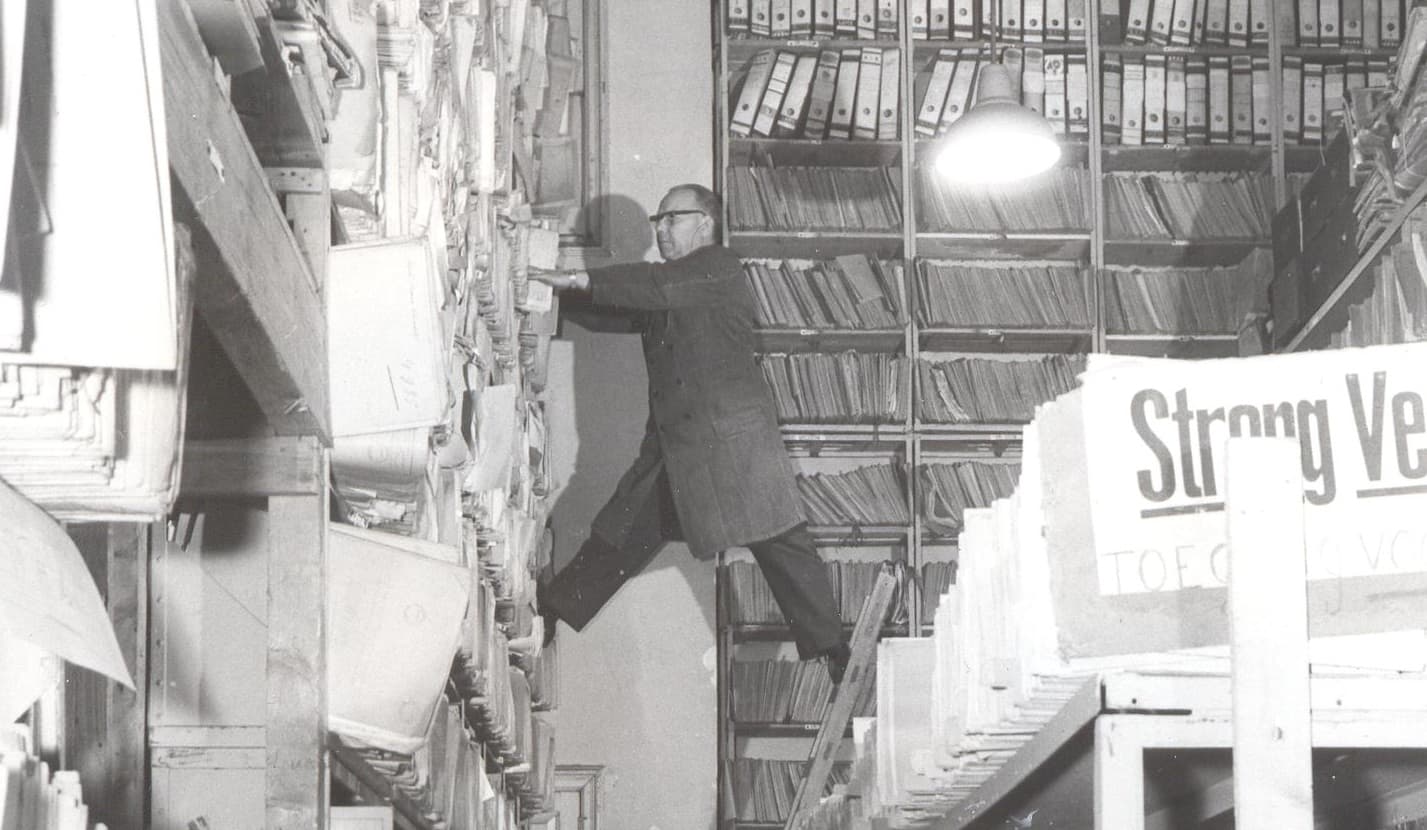
In many cases, searching the archives is not so very different from gathering information on the Internet: if you search critically and patiently, you will find reliable information. But you can also become hopelessly lost; entangled in a jumble of documents that, far from offering clarity, sometimes directly contradict one other, and often offer only loose ends in response to the questions that you would most like to answer.

Chaos in the CABR
In the case of the CABR, there is the additional factor that this archive is not like many other historical archives. The original purpose of preserving the files in the CABR was not to map the past as clearly as possible; its function was very different. The documents were intended for use in legal proceedings: defendants’ interrogations, witness statements and other kinds of evidence, such as diaries and letters. They were all collected immediately after the liberation, under great pressure of time and in extremely chaotic conditions: typewriters, paper and above all competent personnel were in desperately short supply. Despite all of these limitations, swift action was needed: the days and weeks immediately after the liberation saw the arrest of an estimated 150,000-180,000 people who were charged with collaboration with the Germans. Their cases had to be assessed as quickly as possible, if only to determine who had rightly been identified as a collaborator and who had been unjustly detained.
That proved to be an impossible task. Just a small proportion of the files, 13 per cent, would ultimately be tried by a Special Court or dealt with by a Tribunal. The great majority of cases in the CABR were dismissed: conditionally or unconditionally released from prosecution. For more than half of the total of 425,000 suspects, it was never proven whether they were guilty or innocent.
That is a lot of loose ends, especially for an archive that contains so much sensitive personal information – not only about the suspects, but also about their relatives, their victims, and about countless others mentioned in the witness statements and official reports. The accused were often subjected to lengthy interrogations, which have been preserved in the archives. The claims made in these were not always truthful; often defendants simply said what seemed advisable at the time in order to exonerate themselves. Nor are the witness statements necessarily reliable; some witnesses were driven by private motives, and memories could be distorted by the passage of time. They were selected to make incriminating statements, or to prove the innocence of the accused. In most cases, it is no longer possible to determine who was right and who was wrong. What is more, over half of the cases never ended in a decision; and even when cases were dealt with by a Special Court or Tribunal, there was frequent confusion about what exactly had happened, and the judges concluded that little could be established with any certainty.
Guilty or innocent?
The story of the mysterious double-agent
In one of the most notorious cases in the Special Jurisdiction, the question of what exactly happened and whether the defendant was guilty or not was surrounded by confusion and deception for years. This concerned the case against a man who was widely regarded as the biggest traitor of the war: Anton van der Waals. He had betrayed 83 members of the resistance to the Germans. Those were just the named victims, about whom the prosecutor had been able to gather enough evidence on which to base the case. Everyone assumed that the actual number of victims was many times higher.
From the beginning of the war, Van der Waals had infiltrated various resistance groups, each time using a different identity, whereby he tended to present himself as a secret agent who had been dropped by London to maintain contact with the resistance in occupied territory. He passed on the information that he gathered in this way to his handlers in the Gestapo. One resistance group after another was rounded up as a result of his actions. Half of his victims were shot or died in concentration camps.
Van der Waals was high on the Dutch resistance groups’ wanted list of collaborators, but in the months following the liberation he was nowhere to be found. Only in September 1946 did the Dutch authorities manage to capture him. From that time, the investigative services worked for 1.5 years on the evidence against Van der Waals, whereupon he was finally brought before the Special Court in Rotterdam in April 1948. The charges were therefore documented extensively. ‘The reports in the dossier run to 1,467 pages’, reported Het Vrije Volk. ‘Seven hundred and fifty seven witnesses were heard.’ The public prosecutor (the ‘procurator fiscal’, as he was known in the Special Jurisdiction) had selected the 46 most incriminating witnesses to give testimony in court.
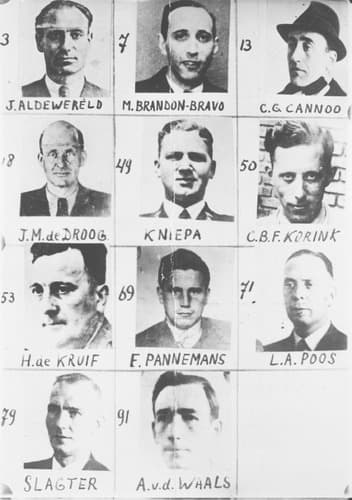
Bron: Beeldbankwo2, collectie NIOD 76724
The most incriminating statement came from the person who had been Van der Waals’ handler during the occupation: Joseph Schreieder, head of the counter-espionage department of the German police. In his statement, Schreieder emphasised that Van der Waals had spied for the Germans of his own accord; he had never been compelled to do so. But he had been well rewarded: 1,100 guilders per month, with 5,000-guilder bonuses, and one time even 50,000 guilders. ‘I was completely satisfied with him’, said Schreieder in the court. 'We considered him to be utterly reliable.’
With so much evidence against him, the idea that Van der Waals might try to prove his innocence seemed futile. And yet that is exactly what he attempted to do: according to his defence in the Rotterdam courtroom, whilst he had indeed betrayed all those resistance fighters to Schreieder, he had done so in the full conviction that he was actually helping the Allies in the process.
Van der Waals’ lawyer explained in court how this had happened: as early as 1938, Van der Waals had been introduced to a man who called himself John Verhagen. They sat in a cafe near the port of Rotterdam and exchanged telephone numbers. ‘It was immediately noticeable that this man, in appearance, looked very much like me.’
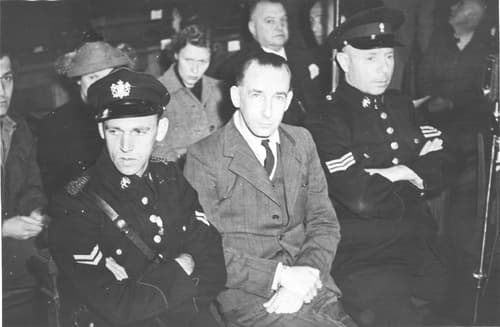
Beeldbankwo2, collectie NIOD 38570.
In 1940, John suddenly contacted him again, asking whether he could pass on information about German ships in the port of Rotterdam. And from that time onwards, the tasks became increasingly serious, and even included infiltrating resistance groups. During interrogations prior to the court case, Van der Waals had repeatedly returned to this mysterious figure, sometimes calling him John Verhagen, other times Emile Verhagen. Every version of the story concerned a British secret agent who gave him orders from London that were intended to aid the Allied struggle, even though the contrary sometimes seemed to be true. Yet they always turned out to serve a higher purpose: the task of handing over a Rotterdam resistance group to Schreieder, for example, was actually intended to save the lives of the resistance fighters and prevent them falling into the hands of the SS.
That was because Schreieder himself, Van der Waals claimed during the trial, was actually on the right side too. In a secret conversation, the German police chief had confided to him that he was working for the Allies. ‘He compared himself to a general who sacrifices 1,000 men in order to save 30,000.’ In that same conversation, Schreieder had promised him that the captured resistance members would come to no harm. They would be locked up in a camp where they would be treated well, and their lives would be spared.
It was an intriguing story that, according to Van der Waal’s lawyer, was linked to persistent rumours then circulating in the media about a double game by the British Secret Services, the so-called ‘Englandspiel’: time after time during the occupation, secret agents had been sent to Dutch territory, only to be arrested by the German Sicherheitsdienst.
How had the Germans known where and when the agents would land? Did the Allies do this deliberately? Had there been a larger strategic purpose to the action, such as keeping German attention fixed on the West? And if counter-espionage operations like these had been going on, was it really so far-fetched to imagine that Van der Waals and Schreieder had been involved in such intrigues? ‘To solve these many mysteries’, Van der Waals’ lawyer concluded, ‘I propose that the court (...) consider suspending this case for at least half a year.’
The Englandspiel
During the war, dozens of secret agents from the newly established British Special Operations Executive (SOE) were dropped over Dutch territory to set up an underground sabotage and intelligence network. Dozens of these agents were arrested almost immediately after they landed. Several of them were forced by the Germans to maintain radio contact with England and behave as though everything was going to plan. The Germans hoped in this way to obtain intelligence from the British Secret Services; hence the name ‘Englandspiel’, which refers to the German attempt to manipulate British intelligence.
Before landing in occupied territory, the SOE agents had agreed that if captured, they would hide warnings in their radio communications. These warnings were therefore included in all of the messages that they were forced to send by the Germans, but the SOE continued to send secret agents to the Netherlands. In the end, the Germans captured 59 agents, 54 of whom died in detention.
Van der Waals’ defence was immediately dismissed by many in the media as the lies of a professional conman. Nevertheless, some newspapers considered the suggestion of a connection with the Englandspiel too interesting to dismiss out of hand. And with that, some explicitly entertained the possibility that Van der Waals’ claim might contain a grain of truth after all. ‘Was Schreieder playing a double game? Van der Waals as a member of the Secret Service...’ ran the headline in the respectable Catholic daily De Tijd on 24 April 1948. Following a detailed report on the plea made by Van der Waals’ lawyer, the reporter mused: ‘Are there revelations here that more than merit the effort of a thorough investigation? Are matters being disclosed that are of utmost importance and of which the Dutch people should certainly take note, or are these astonishing claims merely the product of a deranged mind, one that is making every effort to avoid the death penalty (...) It is very difficult to give any satisfactory answer to these questions.’
Two weeks later, on 7 May 1948, the Special Court gave its verdict. It found that Van der Waals’ defence – that he had believed that he was carrying out Allied orders – lacked any credibility; he had made no effort to find out whether Schreieder or Verhagen did indeed work for British intelligence. The Court also considered the connection with the Englandspiel unproven, meaning that it would be pointless to investigate it further in this case. Concerning the question of whether there had ever been a mysterious secret agent called Verhagen, who had given him orders: according to the Special Court, ‘nothing whatsoever had been proved during the hearing; the existence or otherwise of this figure has not been established in court, so the defendant's defence in this regard must be rejected’.
Nevertheless, doubts persisted in some circles as to whether there might have been a mysterious British double agent in the Van der Waals case. In June 1948, the communist newspaper De Waarheid reported that certain eyewitnesses had seen this Verhagen in the flesh. And as late as May 1949, the newspaper was still insisting that ‘the claims of Van der Waals were never refuted by facts’. Until 1949, De Tijd continued to explore the possibility that Van der Waals’ version of events might ‘reveal something about the background to the still mysterious E-spiel’.
In the meantime, Van der Waals’ lawyer presented new evidence that Verhagen had indeed existed and that the role of the British Secret Service had been covered up. ‘These facts, however, were never investigated. Why not?’
The Special Court of Cassation (the appeals court), which considered the Van der Waals case in May 1949, refused to budge. ‘I think that I know who John is’, said the president of the Council to Van der Waals. ‘It’s you!’ The judgement of the Special Court remained unchanged: Anton van der Waals was sentenced to death.
The ‘unknowability’ of history
Van der Waals’ defence in court may not have saved him from his punishment, but it did ensure that the whole of the Netherlands became captivated by the story of the secret double agent Verhagen, regardless of whether they believed he existed or not.
For the young novelist W.F. Hermans, this fact formed the starting point for his most celebrated novel, The Darkroom of Damocles, in which he asked the same question as Van der Waals’ lawyer: what if the story of Verhagen had in fact been true?
In The Darkroom of Damocles, the protagonist Henri Osewoudt meets a mysterious man during the occupation: a certain Dorbeck, who bears a striking resemblance to him and who gives him tasks. Initially small requests and then more consequential ones, eventually even liquidations – and Osewoudt is convinced throughout that he is helping the resistance. Until the liberation, whereupon Osewoudt is suddenly arrested, and is told to his incredulity that his actions had resulted in all kinds of Dutch resistance members being arrested by the Germans. Scared out of his wits, Osewoudt stammers that he had carried out Dorbeck’s orders in good faith. But ... Dorbeck is nowhere to be found. And no one believes Dorbeck ever existed.
By the end of the novel, Osewoudt has lost all hope. He keeps calling ‘Dorbeck!’ – the only person who can prove his innocence: ‘Go and find Dorbeck, I say, Dorbeck knows everything. Everything, I say. (...) Dorbeck, where are you? Show yourself!’ But Dorbeck never shows himself. And Osewoudt, screaming, desperately tries to run away from the internment camp where he is being held, and is eventually shot by the guards.
The Darkroom of Damocles has become one of the most famous and most-read classics in Dutch literature. At the end, the book’s millions of readers are left wondering: did Dorbeck really exist, or did he exist only in Osewoudt’s imagination? The novel offers no definitive answer. And that was Hermans’ intention. ‘It’s impossible to determine who Dorbeck was, whether he existed or not, or on whose side he was’, explained Hermans in 1963 to the literary journal Podium. ‘That was the main starting point for me when I began writing The Darkroom of Damocles.’ The whole history of the Second World War was based on unreliable testimonies and distorted memories, Hermans went on to claim in the article. Indeed, this applied to historiography as a whole: ‘... the truth of the historian, compared to that of the physicist, is little more than a fable, a myth, or the delusion of the paranoid.’
That was a provocative statement, especially in the Netherlands shortly after the liberation, which was increasingly basing its moral and political self-image on its wartime past, no less. But for Hermans it was a matter of principle. ‘All of the things that history hands down are nothing but great generalisations. As soon as you delve into the details, you hit a lack of evidence, a lack of documents, contradictory statements, etc.’
And in this way, via the roundabout route of fiction, the case against Anton van der Waals left a significant mark on the image of the Second World War; and for some this even constituted an argument for general scepticism about the reliability of historiography.
Nevertheless, Hermans’ claims about the ‘unknowability’ of history were too negative. While it remained a conundrum in The Darkroom of Damocles as to whether the mysterious double agent Dorbeck ever existed or not, in the actual Van der Waals case, the matter of John, or Emile, Verhagen, was eventually clarified: on the morning of 26 January 1950, a few hours before his death sentence was carried out, Anton van der Waals finally confessed that he had made up the whole story. The newspaper headlines rang out: ‘Van der Waals confesses: (...) The figure of Verhagen was fictional.’

Legal and historical proof
Courtroom evidence and historical sources
Thus, there were some cases in the post-war Special Jurisdiction that were eventually clarified, usually in the course of the legal proceedings themselves. In the end, the question of how much of the recent past could be established with certainty had less to do with the basic principle of the unknowability of history, as Hermans claimed, and much more to do with the reliability of the evidence.
And that was also what the judges in the Special Courts based their decisions on: the question of what had, and what had not, been convincingly proven. By focusing on this question during the Van der Waals case, the Court had avoided the distraction of all the conspiracy theories about double-espionage, and the judges had wasted no time in puncturing the defence’s plea: even if there had been a secret British agent by the name of Verhagen, the defendant would still have been responsible for his own actions.
In their rulings, the Special Courts systematically elucidated which claims they considered to have been substantiated, and where the evidence had been insufficient to form the basis for a conviction. Too little evidence did not automatically mean that the suspect was innocent, however: the logic of the rule of law demands that a suspect can only be convicted of crimes for which there is lawful and convincing evidence.
Such evidence was often lacking, and in many cases the capacity problems at the investigative services or the public prosecution service were a factor. This certainly applied to the hundreds of thousands of cases that were dismissed or left incomplete; in many cases, the procurator fiscal did not even manage to finish the preparatory investigation. Based on these files, nothing can be said about the guilt or innocence of the suspects.
Conversely, a conviction by a Special Court or a tribunal did not automatically mean that all of the accusations had been substantiated, according to the judges. Often, only one or two counts in an indictment were considered by the Court to be proven, and formed the basis for the ruling: enough for a conviction, but not enough to know about the circumstances of the case as a whole. There was simply too little time to get to the bottom of it all. And from a legal perspective, that wasn’t necessary, either. In the thousands of cases of Dutch men who had enlisted in the Waffen SS, for example, simple proof of their membership was considered sufficient for their conviction for entering the service of the enemy. Whatever else they had done in their service for the SS on the Eastern Front (where most of them were deployed), whether they had killings on their conscience, or whether they had been involved in the mass murder of Jewish civilians, was not considered necessary for their trial, and in many cases was not investigated further.
Although the historical importance was not the primary consideration when compiling the files for the Special Administration of Justice, this does not alter the fact that a lot of special historical source material can indeed be found in the CABR files. For some cases, in addition to interrogations and testimonies, letters and diaries were also collected, but it could just as easily happen that the investigative services were satisfied with only proof of membership, as that was enough for a conviction.
Following the same legal logic, it regularly happened that files as thick as fists were compiled, sometimes with hundreds of pages devoted to a single event, on which a whole succession of witness statements were made, while hardly any attention was paid to other aspects. In such cases, the procurator fiscal will have decided to obtain a conviction on the basis of a single offence that he wanted to prove as convincingly as possible, while disregarding the rest.
Users of the CABR will need to bear in mind that in each individual case, all the material that they encounter relates primarily to the procurator fiscal’s indictment and furnishing of proof, how this was countered by the defence lawyer, and what the judges eventually concluded. For every page of every file in the CABR, we need to ask whether reliable information can be distilled from it, or whether we are actually looking at insinuating evidence, misleading statements and testimonies that were intended to get someone exonerated or have them convicted, or sometimes – as in the case of Anton van der Waals – merely to sow confusion.
Even in cases where defendants admitted guilt, the content of their confessions was not necessarily reliable. Often defendants who pleaded guilty were hoping to receive a reduced sentence, by saying that they had been unaware of any serious wrongdoings, or by emphasising that, despite everything, their motives had always been honourable – such as fighting the scourge of Bolshevism, as many an SS officer later claimed.
Invented atrocities
But the CABR also contains the remarkable case of someone who did exactly the opposite: a man – a boy, really – who had enlisted in the Waffen SS when he was 19 years old. Bernard Loohuis was his name, born and raised in Oldenzaal. In the last year of the war, he had fought on the Eastern Front in Austria and Hungary. After the German surrender, he had been taken back to the Netherlands as a prisoner of war and imprisoned in Camp Vught, which at that time served as an internment camp for collaborators. During his internment, he had been interrogated several times. He said that he had joined the SS in a fit of drunkenness. People had held a form in front of him and he had signed it. Only later did he discover that he had enlisted in the SS.
Everything in these initial statements resembles the run-of-the-mill attempts by defendants to emphasise mitigating circumstances. Loohuis’ case changed in the spring of 1946, however, when he wrote a note and gave it to a guard: ‘Guard I have a request please take me to the main guardhouse today and then have me taken back to prison. I have many murders on my conscience and I cannot stand it in the Barracks.’
Loohuis was then interrogated again, and what he said sounded so serious that the chief detective and the chief inspector of the Vught branch of the Office for National Security decided to subject Loohuis to an extensive, days-long interrogation, from 3 April to 10 April 1946. The confessions that he made at that time were so detailed and so horrific that the inspectors decided to carry out further research.
The report of his confession was typed on more than 30 densely written sheets. It is a grim inventory of the most sadistic atrocities that anyone could imagine – and Loohuis had done it all, he claimed, when he was a camp guard at Buchenwald and Dachau. He and his fellow guards had killed and burned alive many thousands of prisoners in brutal, degrading fashion. He had shot prisoners, injected them with poison, starved them, smashed their brains out with iron bars and rifle butts, and herded them into gas chambers. He had worked them to death and killed them in specially designed torture machines, such as a well filled with large knives into which prisoners were thrown by the dozen.
At first, the inspectors who interrogated Loohuis did not know what to do with all of this information. Initially they thought that part of the story might be true. How else to explain how this young man could be so wracked with remorse that he wanted to be locked in the camp’s punishment cell, not in the regular barracks, and was even considering suicide?
On the other hand, they could not imagine that one person could be guilty of so much killing, torture and other crimes. From a practical perspective alone, this would have been virtually impossible in the numbers that Loohuis mentioned. At the end of his confession, Loohuis declared: ‘At a rough, not too high estimate, I personally killed 10,000 (ten thousand) prisoners. (...) In the end, I even found myself enjoying killing the prisoners in the most gruesome ways. My colleagues and I were always trying to find out and use new ways to torture people. To us, a human life counted for nothing.’
But no matter how critically they probed, Louis insisted that he was ‘telling the absolute truth and hadn’t made anything up’. To reach a definitive conclusion, the inspectors decided to ask Loohuis to draw a map of the concentration camps where he claimed to have been a guard, ‘showing the places where, among others, the gallows, gas chambers, crematoriums [sic.], “iron man”, had been located’. They then showed the drawings to prisoners who had been imprisoned in those camps. Their response left no room for doubt: Loohuis had never been to Dachau or Buchenwald. He had no idea what the camps had looked like.
Only later did Loohuis admit that his confession was false; but his stories were not based on total fantasies. He had heard some of what he said about the death camps and all the horrors that had taken place there from fellow SS officers, with whom he had been imprisoned in internment camps after the liberation. He had evidently been haunted by the horrific stories about what had been witnessed in the German concentration camps.
The inspectors from the Office for National Security did not attempt to find a psychological explanation; they left that to the doctors and psychiatrists who were asked to look into the case. The doctor from Vught internment camp diagnosed Bernard Loohuis as a ‘psychopath’; at that time a term that primarily described a certain level of social maladjustment, not a danger to society per se. In the rest of the report, Loohuis was described as an ‘ignorant, rough, indifferent lad with a good heart. He is dependent and easy to influence. When handled in the right way, he is willing and hardworking.’
On 23 June 1947, the case of Bernard Loohuis was addressed by the Almelo district tribunal, which reached the same conclusion as the inspectors from the Office for National Security: Loohuis’ delirious confession had been a fabrication, and he should only be convicted for having enlisted in the SS. For that, he was given a prison sentence of four years, minus the time he had spent in the detention camp. He would soon be able to walk free.
But those who had known Loohuis during his imprisonment were convinced that he would not survive in society without daily assistance. And for that reason, after his case and the conviction by the tribunal, he was referred to the Special Court in Arnhem in the hope of ‘eliciting a detention order from the government’.
On 20 August 1948, Loohuis was sentenced once more, this time by the Special Court in Arnhem, to a prison term of three years and four months minus time in pre-detention, and ‘a governmental detention order, for treatment on its behalf.’ As he had by that time been imprisoned for exactly three years and four months, Loohuis was shortly transferred to the Sint Willibrord foundation in Heiloo, where psychiatric patients were treated.
Capacity problems and release from prosecution
With the necessary time and manpower, investigators from the Special Jurisdiction were frequently able to determine what was true and what was not in the statements by suspects and witnesses. For the vast majority of cases, however, the capacity to do this was simply lacking.
In the autumn of 1945, the government and the House of Representatives realised that it was unsustainable to have more than 100,000 arrested suspects held in detention camps, frequently in squalid conditions, without any idea of when their case would be heard, often without a judge having been able to assess whether there were sufficient grounds for detention. The result was a bill that allowed as many suspects as possible to be sent home; public prosecutors could select those cases that would be unlikely to generate a greater penalty than the pre-detention time already served by the accused. In 1946, 90,000 suspects were thereby granted ‘conditional release from prosecution’. People in this group no longer had to appear before a court or tribunal, but received a standard sanction from the Ministry of Justice, such as the denial of passive or active suffrage for a period of ten years, or a ban from holding public office. Another group of some 30,000 suspects were unconditionally acquitted: their cases were expected to end in acquittal or such a light punishment that further prosecution no longer served any practical purpose.
This latter group of unconditional acquittals, together with the estimated 200,000 dismissed cases, make up some 60 per cent of the criminal files in the CABR. The judicial investigations into these cases were never completed, or never even began. Given that such a large percentage of the archive contains incomplete and thus potentially misleading data, every user of the CABR is confronted with a situation that we must all contend with from time to time: namely, that certain questions – perhaps including the most pressing questions of all – can never be answered.
The ability to accept that there are things that we will never know with absolute certainty has never been the strongest human quality. With the abundance of information on the Internet, this has only become more apparent. The trick is to avoid being paralysed by general scepticism about the knowability of the world or the past, or seduced by theories and speculation for which there is no factual basis whatsoever, but instead to keep focused on what can be established with certainty.
Suspicions raised by the village policeman
In many CABR files, the question that most users consider the most pressing – the question of whether the suspect was guilty or not – cannot be answered for sure. But it may well be true that these same files contain material that allow other, different aspects of a case to be established with certainty.
For example, the CABR contains a file on a farmer from Boekelo, Dirk Ensing, who was accused of betraying Jews he had found hiding in his father-in-law’s henhouse. The village policeman, Hindrik Feikens, who worked in the area around Enschede during the occupation, made an incriminating statement: one summer’s morning in 1944, Dirk Ensing had approached him to report the people in hiding. ‘He also said that his in-laws were scared that they would get into trouble as a result.’ As a police officer, Feikens wanted to have nothing to do with the persecution of the Jews. His response to Ensing’s question was that if Ensing wanted to report the Jewish people in hiding, he shouldn’t come to him, but instead go to his colleagues at the police station in Enschede.
But the policeman didn’t leave it at that. As the day went on, he began to worry that if Dirk Ensing went to the police station, he would tell them that he had reported the crime earlier that day, but that he, Feikens, had refused to do anything about it. That could get him into trouble. So that evening, Feikens stopped by to ask Ensing if he had already been to the police station. When it turned out that he had not, Feikens suggested that they go together. That way, he could keep an eye on whether Ensing said anything about him.
At the police station, the duty officers decided to go and inspect the henhouse with Feikens and Ensing. When they got there, they could clearly see that people had been hiding there, but they had disappeared in the meantime.
According to Feikens’ statement, Ensing had approached him with the intention of reporting the Jews in hiding: Ensing had even told him again, a few days later, that he knew where the Jews’ new hiding-place was.
In his own statement, however, Dirk Ensing told a very different story. While out walking on his father-in-law’s farm, he had indeed found people hiding in the henhouse. They had asked him whether there was anywhere else they could shelter at a time when it was safe for them. Ensing’s father-in-law considered it too risky to allow them to live on his property. A few days later, the henhouse was empty again, but it didn’t take long for new people to come and hide there.
Ensing’s father-in-law did not know what to do, and told his son-in-law to ask Feikens for advice – not with the intention of reporting the people in hiding, Ensing emphasised, because everyone in the village knew that Feikens wanted nothing to do with the persecution of the Jews – but find out how he could best ensure that the people in hiding moved on. The fact that Feikens stopped by to take him to the station that evening thus came as a surprise. Ensing saw little option but to go with him, ‘after first telling him again that it was not my intention to inform on the Jews.’ Ensing vehemently denied having told Feikens a few days later that he knew where the people had gone.
Loose ends and new questions
With regard to the file of Dirk Ensing, and indeed the vast majority of CABR files, anyone who is primarily interested in the question of guilt will be left with all kinds of loose ends. But someone who searches the files to find out what can be established with certainty amid all the different statements may nevertheless be able to draw well-founded conclusions.
For example, we can identify several common elements in the statements by Hindrik Feikens and Dirk Ensing: a number of Jews had indeed hidden in the henhouse belonging to Ensing’s father-in-law, and they had fled elsewhere when asked to move on. In addition, conclusions can be drawn about the different people involved in the case – less so Dirk Ensing himself, but certainly his father-in-law and the policeman Hindrik Feikens: neither of them wanted to be involved in the persecution of the Jews, yet they were not prepared to actively help Jewish people in hiding, either. The moment they faced risks, they took measures to protect themselves, despite knowing that this might endanger the Jews in hiding.
When it comes to the fate of the people in hiding, the file on Dirk Ensing also offers some clarity: after they had fled the henhouse, a clog-maker in Boekelo allowed them to shelter in his hiding-place. They stayed there for four months, until they were discovered during a house-search. They would never return. Only the child in hiding with them, who was not found during the house search, ultimately survived the war.
In the Dutch processing of the Second World War, the question of guilt has always played a central role: who was ‘right’ and who was ‘wrong’. This question naturally played a key role in the Special Jurisdiction too, but – paradoxically enough – the historical value of the files in the archives of the Special Jurisdiction does not lie per se in the answers that they give to the question of guilt; the vast majority of cases were never completed, and even those cases that resulted in convictions seldom offer full clarity with regard to all of the charges brought against a suspect.
Instead, the value often lies in other elements in the files, from which the most reliable information can be distilled: about the role of bystanders, for example, or the fate of the victims, or what daily life was like during the occupation. In the search for the guilty of the war, which is essentially what the Special Jurisdiction was, these elements turn up like incidental discoveries. Eighty years on from the liberation, it is often these findings in particular that turn out to be the most revealing
Sometimes you only find an answer when you ask a different question.
Literature list
- Becker, Frans en Tamara, Het Englandspiel en de geheime diensten in Londen (Amsterdam 2024);
- Belinfante, A.D., In plaats van Bijltjesdag. De geschiedenis van de Bijzondere Rechtspleging na de Tweede Wereldoorlog(Assen 1978);
- Faber, Sjoerd, & Gretha Donker, Bijzonder Gewoon. Het Centraal Archief Bijzondere Rechtspleging (1944-2000) en de 'Lichte Gevallen' (Haarlem 2000);
- Bloem, Rein, ‘Schrijven vind ik alleen de moeite waard als je de ambitie hebt om iets te schrijven, dat nog niet eerder geschreven is’ in Vrij Nederland 8 maart 1969, in Scheppend nihilisme. Interviews met Willem Frederik Hermans ( Amsterdam 1979);
- Hermans, W.F., ‘Blokker en Bommel’ in Podium jrg. 18 nr. 1 (okt 1963) p.44;
- Hermans, W.F., De Donkere Kamer van Damokles (Amsterdam 1958);
- Jong, Loe de, Het Koninkrijk der Nederlanden in de Tweede Wereldoorlog dl 10 & 12 (Leiden 1988);
- Kieft, Ewoud, Oorlogsmythen. W.F. Hermans en de Tweede Wereldoorlog (Amsterdam 2011);
- Kok, Auke, De Verrader. Leven en dood van Anton van der Waals (Amsterdam 2013);
- Meiboom, W.E., Bijzonder bestraft. Context, analyse en waardering van de bijzondere rechtspraak door de Kamer Groningen van het Bijzonder Gerechtshof Leeuwarden en van cassaties in Groningse zaken [proefschrift Leiden 2016];
- Meihuizen, Joggli, Noodzakelijk Kwaad. De betraffing van economische collaboratie in Nederland na de Tweede Wereldoorlog (Amsterdam 2003);
- Otterspeer, Willem, Dorbeck, waar ben je? Een biografisch essay over De Donkere Kamer van Damokles (Amsterdam 2012);
- Romijn, Peter, Snel, streng en rechtvaardig. Politiek beleid inzake de bestraffing en reclassering van ‘foute’ Nederlanders (Houten 1989);
- Severein, M., Alles is gedaan om het recht te vinden. Bijzondere Rechtspleging in Leeuwarden, 1945-1949 (Hilversum 2017);
- Tames, Ismee, ‘Oorlogsverledens online?’ online op WO2-portal;
- Tames, Ismee, ‘Digitale ontsluiting van het Centraal Archief Bijzondere Rechtspleging : Mogelijkheden en onmogelijkheden’ in: Tijdschrift voor Geschiedenis jrg.133 afl.2 (2020) pp. 303-324;
- Uildriks, Klaas Jan, ’De Palestina-Pioniers in Enschede' in: 'n Sliepsteen (2020), pp. 23-25;
- Visser, Frank, De zaak Antonius van der Waals (Den Haag 1974).
Subscribe for the newsletter
Stay up to date every month about new publications, activities and more.
NIOD
Herengracht 380
1016 CJ Amsterdam
Visiting hours study room
Tue - Fri: 09:00 - 17:30 hour
Closed on Monday
Note:
The NIOD itself is open as usual on Monday.
Donate archival material to the NIOD?
The NIOD is an institute of the Royal Netherlands Academy of Arts and Sciences