History of NIOD
The institute was founded on 8 May 1945 to conduct independent research into the history of the Second World War in the Netherlands and the Netherlands East Indies. Since then it developed into a national and international centre for interdisciplinary research into the history and societal impact of world wars, large-scale violence and genocides.
During the Second World War, plans were already being drawn up to found a centre for war documentation after the liberation. The idea was developed by a group of professors led by historian Prof. N.W. Posthumus. They were particularly interested in collecting and organising material relating to the Netherlands during the period of German occupation. On the other side of the North Sea, the Dutch government in exile in London was thinking along the same lines. In late March 1944, for example, Minister Bolkestein called on the Dutch people via Radio Oranje to keep diaries and letters relating to the war. The documents would be collected once the Netherlands had been liberated.
The establishment of the National Bureau for War Documentation
The Netherlands was liberated on 5 May 1945. No time was wasted in setting up a documentation centre; just three days later, on 8 May 1945, the ‘National Bureau for War Documentation’ became a reality. The institute was founded to conduct independent research on the history of the Second World War in the Netherlands and the Netherlands East Indies. Historian Dr Loe de Jong, who had worked at Radio Oranje in London during the war, became its director on 1 October 1945. The name ‘national bureau’ was changed to ‘National Institute for War Documentation’.
In the initial years, the institute’s main task was to gather material on the Netherlands and the Netherlands East Indies during the Second World War. Radio appeals, newspaper ads and posters were used to call on the Dutch public to send in documentation.
Collecting war documentation and conducting research
Important documents, such as diaries, correspondence and photo albums, were entrusted to the institute. In addition, the staff of the documentation centre frequently went out searching for material themselves. In 1946, for example, Dr Loe de Jong and deputy director Dr A.E. Cohen discovered a large part of the archive of the Reichskommissariat in den Niederlanden in Münster.
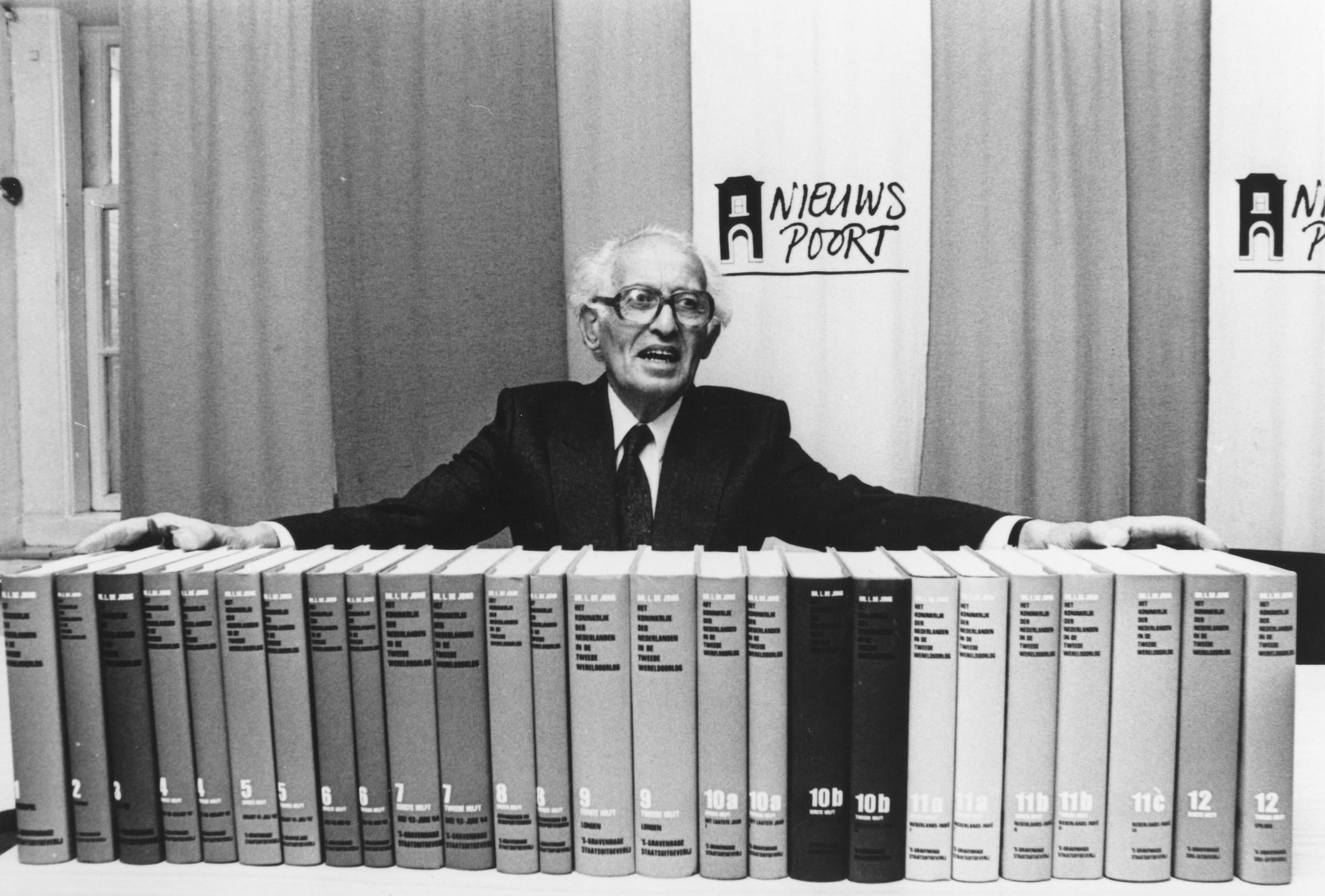
Besides gathering and cataloguing all these documents, the national institute also undertook research. One of the results was Loe de Jong’s multi-volume historical work Het Koninkrijk der Nederlanden in de Tweede Wereldoorlog [The Kingdom of the Netherlands in the Second World War]. The first volume was published in 1969, the last in 1988. In addition to this ‘life’s work’ by Loe de Jong, other staff at the institute published numerous studies that are today considered classics in the historiography of the Second World War in the Netherlands and the former Netherlands East Indies.
Expansion of the research field
In the 1990s, major changes took place within the documentation centre. First of all, in 1997 the institute moved from its old address on Herengracht 474 to its current premises at Herengracht 380. In addition, in 1999 it became part of the Royal Netherlands Academy of Arts and Sciences (KNAW), and changed its name to the Netherlands Institute for War Documentation (NIOD).
The most important change was substantive in nature. As the millennium approached, NIOD embarked on a more international path. It broadened its field of research in relation to both time and place. The period prior to, the aftermath and the processing of the Second World War were now addressed in research as well, and greater attention was paid to events in the former Netherlands East Indies and to international comparative research. There was a considerable rise in the number of partners in academia and civil society at home and abroad.
The Srebrenica investigation
In 1996, NIOD was commissioned by the Dutch government to conduct an investigation into the fall of the enclave of Srebrenica in Bosnia, and Dutch involvement in the conflict. This marked the first time that NIOD had ventured into a research field other than the one for which it had become well known. The investigation gave NIOD the opportunity to address social and international questions about ‘Srebrenica’ through intensive research.
The report was published on 10 April 2002: Srebrenica. Een ‘veilig’ gebied. Reconstructie, achtergronden, gevolgen en analyses van de val van een Safe Area. [Srebrenica. A ‘safe’ area. Reconstruction, background, consequences and analyses of the fall of a Safe Area]. The second Kok Cabinet resigned in the wake of the report, and the Dutch House of Representatives subsequently launched a parliamentary inquiry.
In 2016, NIOD was commissioned by the government to undertake a survey of sources and scientific literature relating to the fall of the enclave of Srebrenica on 11 July 1995 that had become available since 2002.
This survey focused on two issues that had attracted considerable publicity: international political decision-making on the provision of air support, and prior knowledge within intelligence agencies about the Bosnian-Serb attack on the safe area of Srebrenica and its exact purpose. Against the background of the findings of NIOD’s 2002 study, this survey brought greater clarity to the questions surrounding air support and prior knowledge.
Merger with the Centre for Holocaust and Genocide Studies
In 2010, NIOD merged with the Centre for Holocaust and Genocide Studies (CHGS) to form the NIOD Institute for War, Holocaust and Genocide Studies. The CHGS, founded in 2002, had quickly developed into an independent institute. With its academic and societal activities, the CHGS approached the current problem of genocide as a global phenomenon from a comparative perspective. In partnership with the University of Amsterdam, the CHGS had established the Master’s programme in Holocaust and Genocide Studies (MA HGS)
Like NIOD, the CHGS focused its activities at the interface of scholarship and society. Whereas NIOD took the Second World War as its starting point, the CHGS covered the whole world, using the concept of genocide and the discussions about its meaning as its point of reference.
Independence, decolonisation, violence and war in Indonesia (ODGOI)
In September 2016, in response to growing pressure from society and academia, the Dutch government decided to facilitate in-depth independent research on the war in Indonesia. As such, the government challenged the official position, taken by the Dutch government in 1969, that there had been no ‘systematic cruelty’ on the part of the Dutch army during that war, and that the ‘armed forces as a whole had behaved correctly in Indonesia’.
In early 2017, the government provided funding to support an independent research programme by the Royal Netherlands Institute of Southeast Asian and Caribbean Studies (KITLV), the Netherlands Institute of Military History (NIMH) and NIOD.
The research programme on Independence, decolonisation, violence and war in Indonesia, 1945-1950 (ODGOI) focused primarily on the use and consequences of extreme violence by the Dutch armed forces during the Indonesian War of Independence, and the extent to which political and legal responsibility was taken for this both at the time and later, as viewed in a broader historical, political and international context.
The findings of the research were presented on 17 February 2022. The researchers concluded that the position taken in 1969 was untenable. Sources showed that the Dutch government and military leadership had purposefully condoned the systematic and widespread use of extreme violence by the Dutch armed forces in the war against the Republic of Indonesia.
The Cabinet accepted the main conclusions and apologised to the Indonesian population for the structural and extreme violence. In doing so, it specifically acknowledged the suffering that had been inflicted on veterans and conscientious objectors.
The history of Herengracht 380
NIOD is housed in a monumental building on Herengracht in Amsterdam. The building is a government-owned listed property and leased by the KNAW. It was assigned to NIOD because it has large vaults to house the archives. The building has a rich past, in which the darker chapters of Dutch history are amply represented. Indeed, the history of the building, which is composed of two adjoining premises, is linked to NIOD’s field of research in a rather incredible way.
In the article ‘If walls could speak. The history of Herengracht 380-382’, NIOD’s former director Frank van Vree describes the former residents and users of Herengracht 380-382.
Subscribe for the newsletter
Stay up to date every month about new publications, activities and more.
NIOD
Herengracht 380
1016 CJ Amsterdam
Visiting hours study room
Tue - Fri: 09:00 - 17:30 hour
Closed on Monday
Note:
The NIOD itself is open as usual on Monday.
Donate archival material to the NIOD?
The NIOD is an institute of the Royal Netherlands Academy of Arts and Sciences