
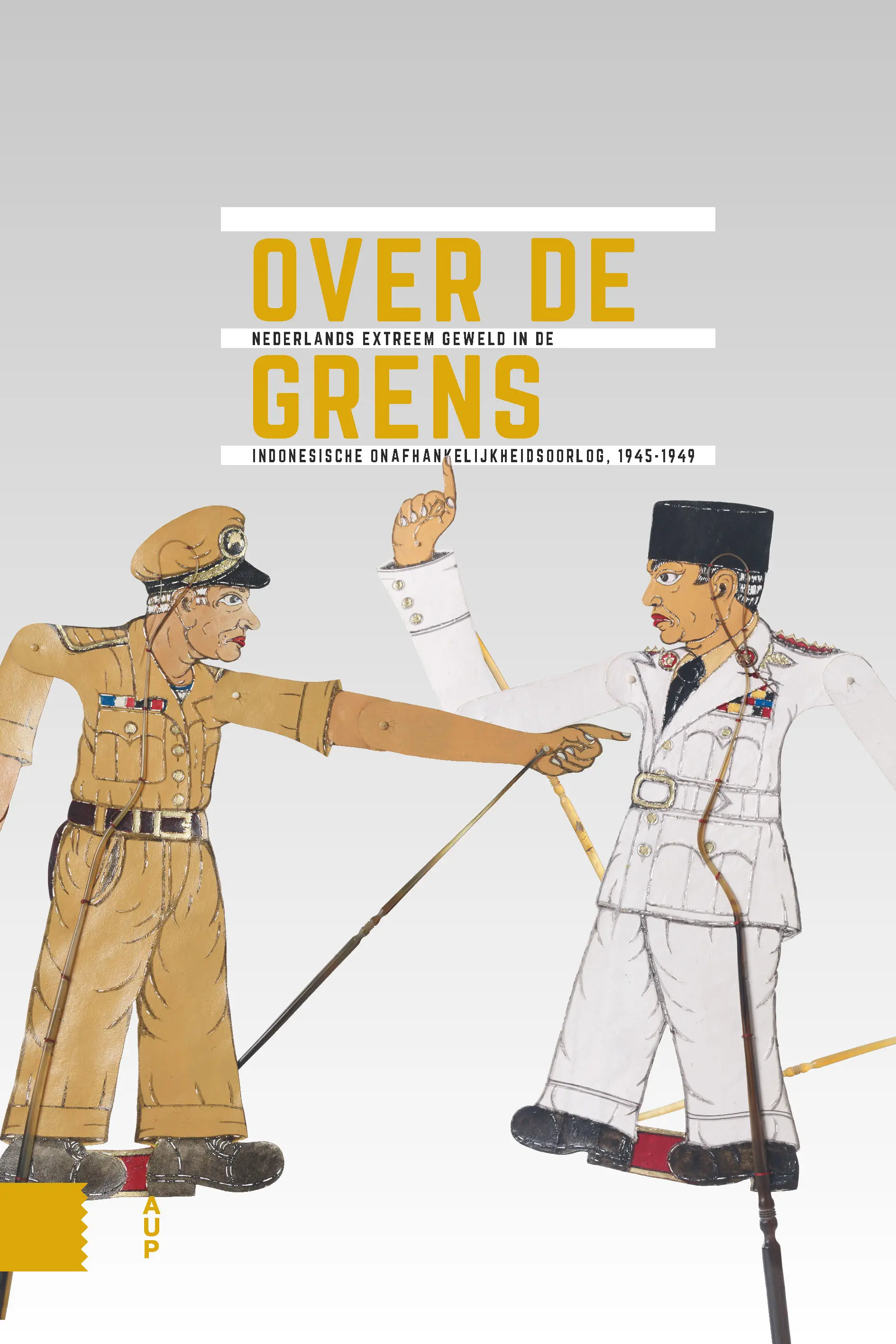
Beyond the Pale
Publication
·
2022
·
Amsterdam University Press, Amsterdam
Dutch Extreme Violence in the Indonesian War of Independence, 1945-1949
On 17 August 1945, two days after the Japanese surrender that also brought an end to the Second World War in Asia, Indonesia declared its independence. The declaration was not recognized by the Netherlands, which resorted to force in its attempt to take control of the inevitable process of decolonization. This led to four years of difficult negotiations and bitter warfare.
In 2005, the Dutch government declared that the Netherlands should never have waged the war. The government’s 1969 position on the violence used by the Dutch armed forces during the war remained unchanged, however: although there had been ‘excesses’, on the whole the armed forces had behaved ‘correctly’. As the indications of Dutch extreme violence mounted, this official position proved increasingly difficult to maintain. In 2016, the Dutch government therefore decided to fund a broad study on the dynamics of the violence.
The most important conclusions of that research programme are summarized in this book. The authors show that the Dutch armed forces used extreme violence on a structural basis, and that this was concealed both at the time and for many years after the war by the Dutch government and by society more broadly. All of this – like the entire colonial history – is at odds with the rose-tinted self-image of the Netherlands.
During the research, the authors – Gert Oostindie, Thijs Brocades Zaalberg, Eveline Buchheim, Esther Captain, Martijn Eickhoff, Roel Frakking, Azarja Harmanny, Meindert van der Kaaij, Jeroen Kemperman, Rémy Limpach, Bart Luttikhuis, Remco Raben, Peter Romijn, Onno Sinke, Fridus Steijlen, Stephanie Welvaart, and Esther Zwinkels – were all affiliated with the Royal Netherlands Institute of Southeast Asian and Caribbean Studies (KITLV), the Netherlands Institute for Military History (NIMH) or the NIOD Institute for War, Holocaust and Genocide Studies.
The final editing was done by Gert Oostindie, Ben Schoenmaker and Frank van Vree. The Indonesian historian Hilmar Farid wrote the epilogue.
This publication is a result of the research programme Independence, Decolonization, Violence and War in Indonesia, 1945-1950.
The book is also available via:
About the research programme
The research focused primarily on the use of extreme violence by the Dutch armed forces during the Indonesian War of Independence, the consequences it had, and the extent to which political and legal responsibility was taken for the extreme violence both at the time and later, all viewed in a wider historical, political and international context.
The research was conducted by more than twenty-five Dutch academics, in parallel with two international projects: a project by the Universitas Gadjah Mada (UGM) with eleven Indonesian researchers, and a project with six international experts, carried out in 2019 at the Netherlands Institute for Advanced Studies (NIAS). The programme had a scientific advisory committee and a societal feedback group.
The researchers concluded that the position taken in 1969 is untenable. Although it is not possible to give precise figures for the crimes and numbers of victims, the sources show that the use of extreme violence by the Dutch armed forces was not only widespread, but often deliberate, too. It was condoned at every level: political, military and legal. The reason for this was that the Netherlands wanted to defeat the Republic of Indonesia – which had declared independence on 17 August 1945 – at any cost, and was prepared to subordinate almost everything to this goal. In doing so, ethical boundaries, including those that applied at the time, were emphatically crossed.
In the end, the Netherlands fought a hopeless war that became increasingly violent, while the Indonesians waged a fierce guerrilla war. Forms of extreme violence were used by all armed parties to this conflict. The intense violence in the earliest phase of the Indonesian revolution – directed against Indo-Dutch and Moluccans among others, and known in the Netherlands as the ‘bersiap period’ – did play a role in the dynamics of the violence, but it was not the reason for the military reoccupation.
During the war, the Dutch armed forces used extreme violence on a frequent and structural basis, in the form of extrajudicial executions, ill-treatment and torture, detention under inhumane conditions, the torching of houses and villages, the theft and destruction of property and food supplies, disproportionate air raids and artillery shelling, and what were often random mass arrests and mass internment.
The Dutch armed forces as an institution were responsible for the violence used, including the extreme violence. However, they operated in close consultation with and under the responsibility of the Dutch government. Politicians in the Netherlands, with their supporters’ backing, paid little attention to the extreme violence and failed to take responsibility for it in practice. They were able to follow this line because Dutch society was broadly supportive of the war. Moreover, there was very little critical scrutiny from society, including the media. The geographical distance, and above all the mental distance, played a key role in this. It is evident that at every level, the Dutch unquestioningly applied different standards to the colonies and colonial ‘subjects’.
The research shows that the vast majority of those who bore responsibility on the Dutch side – politicians, officers, civil servants, judges and others – had or could have had knowledge of the systematic use of extreme violence, but that there was a collective willingness to condone, justify and conceal it, and to let it go unpunished. All of this happened with a view to the higher goal: that of winning the war against the Republic and taking control of the process of decolonization. At every level, people were prepared to set aside written and unwritten legal rules and their own sense of justice.
The Dutch underestimation and rejection of the widely supported Indonesian independence movement was grounded in a deep-rooted colonial mentality. Politicians, military personnel and administrators in the colony and in the Netherlands were convinced of the superiority of the Dutch, and their attempts to control Indonesia were mainly driven by economic and geopolitical motives, and by the idea that they still had a mission in the ‘East’ and were indispensable there. This attitude resulted in crucial errors of judgement, both militarily and politically, and the Netherlands became very isolated internationally.
The formal transfer of sovereignty – which eventually took place on 27 December 1949 – was the result of heavy pressure from the international community and the realization that the war could not be won. In the aftermath, Dutch politicians attempted to keep the war, and certainly questions about the extreme violence, out of the political arena as far as possible, both in order to cover up their own failings and to spare war veterans and the Indo-Dutch and Moluccan communities. It was convenient that Indonesia did not press for an investigation. This situation only changed in fits and starts; it was many years before more space emerged in Dutch society to reflect critically on this episode, which was so at odds with the deeply rooted rose-tinted national self-image.
Watch the full livestream of the presentation of the research programme’s findings via the links below:
Part 1 (English)
Part 2 (English)
Part 3 (English)
Overview of publications from the research programme
- Beyond the Pale. Dutch Extreme Violence in the Indonesian War of Independence, 1945-1949
- Maarten van der Bent (ed.), Van Rij en Stam. Rapporten van de Commissie van onderzoek naar beweerde excessen gepleegd door Nederlandse militairen in Indonesië, 1949-1954 (Bronnenpublicatie) (in Dutch)
- Thijs Brocades Zaalberg, Bart Luttikhuis (eds.), Empire’s Violent End. Comparing Dutch, British and French Wars of Decolonization, 1945-1962
- Eveline Buchheim, Satrio (Ody) Dwicahyo, Fridus Steijlen, Stephanie Welvaart, Sporen vol betekenis / Meniti Arti. In gesprek met 'Getuigen & Tijdgenoten' over de Indonesische onafhankelijkheidsoorlog / Bertukar Makna bersama 'Saksi & Rekan Sezaman' tentang Perang Kemerdekaan Indonesia (in Dutch and Indonesian)
- Esther Captain, Onno Sinke, Resonance of Violence. Bersiap and the Dynamics of Violence in the First Phase of the Indonesian Revolution, 1945-1946
- Azarja Harmanny, Grof geschut. Artillerie en luchtstrijdkrachten in de Indonesische onafhankelijkheidsoorlog, 1945-1949 (in Dutch)
- Meindert van der Kaaij, Een kwaad geweten. De worsteling met de Indonesische onafhankelijkheidsoorlog vanaf 1950 (in Dutch)
- Jeroen Kemperman, Emma Keizer, Tom van den Berge, Diplomatie en geweld. De internationale context van de Indonesische onafhankelijkheidsoorlog, 1945-1949 (in Dutch)
- Rémy Limpach, Stumbling in the Dark. The Battle for Intelligence in the Indonesian War of Independence, 1945-1949
- Bambang Purwanto, Roel Frakking, Abdul Wahid, Gerry van Klinken, Martijn Eickhoff, Yulianti, Ireen Hoogenboom (eds), Revolutionary Worlds. Local Perspectives and Dynamics of the Indonesian Independence War, 1945-1949
- Remco Raben, Peter Romijn, Tales of Violence. Dutch Management of Information in the Indonesian War of Independence, 1945-1949
- Abdul Wahid, Yulianti (eds), Onze Revolutie. Bloemlezing uit de Indonesische geschiedschrijving over de strijd voor de onafhankelijkheid, 1945-1949 (in Dutch)
- Esther Zwinkels, The Harsh Sword of Lady Justice. Law and Impunity in the Indonesian War of Independence, 1945-1949 (expected date of publication: January 2027)
Author

Prof. dr. Martijn Eickhoff
Director

Dr. Jeroen Kemperman
Researcher
Subscribe for the newsletter
Stay up to date every month about new publications, activities and more.
NIOD
Herengracht 380
1016 CJ Amsterdam
Visiting hours study room
Tue - Fri: 09:00 - 17:30 hour
Closed on Monday
Note:
The NIOD itself is open as usual on Monday.
Donate archival material to the NIOD?
The NIOD is an institute of the Royal Netherlands Academy of Arts and Sciences