The War in Court Consortium
The War in Court Consortium comprises the National Archives of the Netherlands, WO2Net Netwerk Oorlogsbronnen, the Huygens Institute for the History of the Netherlands and the NIOD Institute for War, Holocaust and Genocide Studies. These organisations are working together to digitise the Central Archive for Special Jurisdiction (CABR), make it fully searchable, provide explanations and context, and make it available online.
NIOD’s role in the War in Court Consortium
Each of the consortium partners plays a specific role. The National Archives administers the CABR and is responsible for digitisation within the project. WO2Net provides background information and additional details for the digitised CABR files. The Huygens Institute draws on its technical expertise to make the scans digitally searchable, and NIOD contributes its specialist knowledge to interpret the significance of the CABR within the historiography and culture of remembrance.
The Central Archive for Special Jurisdiction
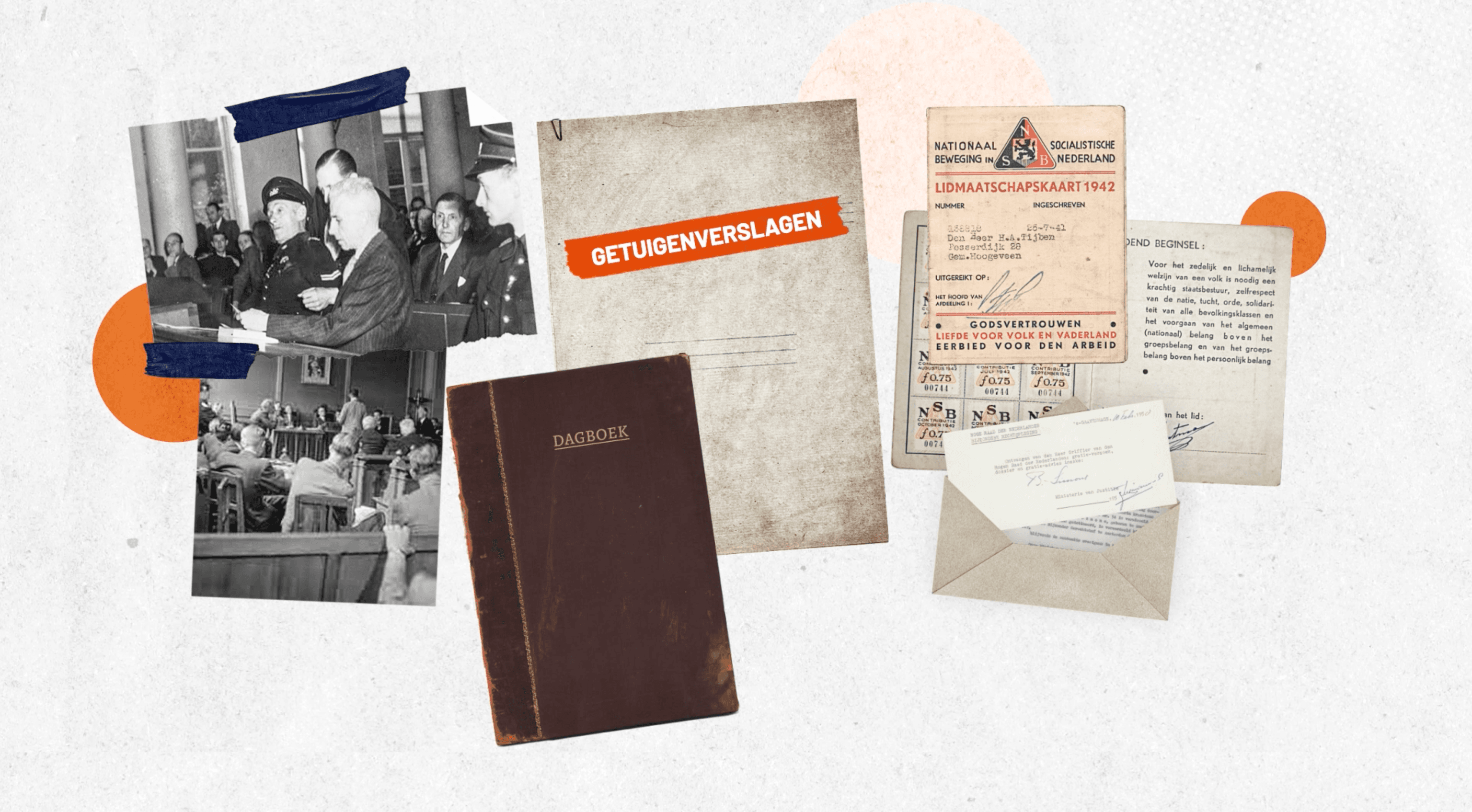
The CABR contains the files of around 425,000 individuals who were suspected of collaborating with the Germans. The files, which run to nearly 4 km, contain witness statements, NSB membership cards, diaries, applications for clemency and, in some cases, photos. Following investigations, the charges against the majority of the suspects were dropped. Twenty per cent of the suspects were eventually convicted by a special court or tribunal, and almost 1,900 of them were jailed for ten years or more. More information about the CABR is available at www.oorlogvoorderechter.nl (available in Dutch only).
Making the CABR readable and searchable
In September 2023, the National Archives started digitising the CABR. The aim is to carry out an average of 152,000 scans a week. Artificial intelligence will then be used to make them digitally readable and searchable. To enhance understanding of the CABR documents and place them in a wider context, extra background information will be added, as well as links to sources on the same topic in other CABR collections.
During the project, the parties involved discussed the management of the archive with interest groups. Having the opportunity to search the CABR archives will provide new insights into events during the Second World War in all their diversity and from different perspectives. The project will run until the end of 2027.
Online availability of the CABR postponed
The first CABR files were meant to become available online in January 2025 via the website www.oorlogvoorderechter.nl. Following a warning issued by the Data Protection Authority (Autoriteit Persoonsgegevens, AP) in late 2024, it was decided to postpone the online publication of the CABR files for the time being. The minister acknowledged the importance of making this archive available in digital form, however, and a process was initiated to amend the law to make this possible. In anticipation of this, a temporary solution has been developed to enable searches within the digitised part of the CABR.
Digitised part of the CABR consultable on-site
Since 3 February 2026, two computers have been available in NIOD’s reading room for consulting the digitised part of the Central Archive for Special Jurisdiction (CABR). In addition to NIOD and the National Archives in The Hague, it is also possible to consult the digitised CABR at the Regional Historical Centres in Arnhem, Assen, Den Bosch, Deventer, Groningen, Haarlem, Heerlen, Leeuwarden, Lelystad, Middelburg and Utrecht.
Book a computer to consult the CABR
You can book a computer at NIOD to consult the CABR during a 3.5-hour time slot. This allows multiple people to carry out research on any given day. You are also welcome to browse the rest of the NIOD collection during your visit.
The two specially secured computers in the NIOD reading room are available for people with a research interest, i.e., a (personal) interest in conducting research in the CABR. Before being able to view a file, you will be issued with a decision granting access.
The CABR contains data on individuals who may still be alive. To protect their privacy, researchers wishing to conduct academic research in the CABR must complete an additional form (available in Dutch only), explaining how they will handle the sensitive personal data in the archive. This form can also be completed on arrival at NIOD.
The computers must be booked in advance. You may bring one person with you on your visit. Due to the restricted public availability of the material, you are not permitted to make any reproductions (print or photo). You are allowed to make notes. Computers can be booked up to one month in advance. In order to allow as many people as possible to consult the CABR digitally, you may book a maximum of one time slot per week.
Subscribe for the newsletter
Stay up to date every month about new publications, activities and more.
NIOD
Herengracht 380
1016 CJ Amsterdam
Visiting hours study room
Tue - Fri: 09:00 - 17:30 hour
Closed on Monday
Note:
The NIOD itself is open as usual on Monday.
Donate archival material to the NIOD?
The NIOD is an institute of the Royal Netherlands Academy of Arts and Sciences