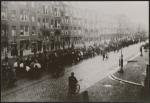
Photo: NIOD Image Bank WW2
Digitisation project: the razzia of Rotterdam
The digitisation project ‘Razzia van Rotterdam Digitaal’ focuses on digitising a unique research collection created and gathered by Ben Sijes. Sijes worked at the National Institute for War Documentation (RIOD) – today’s NIOD. He assembled the collection between 1946 and 1951 in order to write his book, ‘De razzia van Rotterdam, 10-11 november 1944’. The current digitisation project is making Sijes’ working archive – full of interviews, correspondence and questionnaires about the raids in Rotterdam in 1944 – visible, sustainable and usable again. NIOD’s target audience is both professional historians and a wider group of interested parties.
The razzias or raids in and around Rotterdam formed a striking episode in the German occupation of the Netherlands in World War II. Around 52,000 men were taken from their homes in a very short period of time. They were set to work in the east of the Netherlands or worked in the Arbeitseisatz in Germany.
In 1951, in the foreword to Sijes’ book, the directors of RIOD wrote the following about the events: “Few actions by the German authorities in the Netherlands would claim so many victims, or intervene so rapidly and so dramatically in the lives of our people.”
Sijes assembled almost six metres of documentation during the years in which he worked on his book. The result, 'Research Collection 258: Razzia of Rotterdam', contains many questionnaires completed by representatives of various communities, private letters, correspondence with different agencies, and hundreds of interview reports. Sijes personally corresponded with his research subjects, administered questionnaires and held interviews. His subjects included a wide range of witnesses and contemporaries: former members of the resistance, burgomasters, public officials, policemen, the employees of various companies and, of course, the victims of the raid and/or their relatives.
According to Sijes, these interviews and questionnaires were an essential supplement to the diaries and letters as sources. As he wrote: “Reading through the letters and diaries, we found that the writers [...] had paid little attention to the behaviour of the people around them during the raid, and to the question of how they themselves had been affected by this.” Sijes believed that only his interviews and surveys could fill this gap.
As well as this insight into the private lives of the people who lived through this wartime episode, the documentation from the period 1946-1951 offers an interesting perspective on the historical events themselves, thanks to the unusually minimal influence of the passage of time between the historical event and the interaction with the researcher. Unlike many Oral History projects held decades later, Sijes’ documentation is not affected by the stories that have since become dominant in collective memory and popular culture. In addition, increased digital access to this collection contributes to our knowledge of the work and research processes of early researchers at the institute currently known as NIOD.
Sustainable accessibility
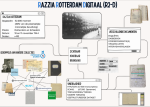
The digitisation project on the razzia of Rotterdam aims to increase the accessibility and usability of ‘Research Collection 258: Razzia of Rotterdam’ for both a wide audience and for professional historical researchers. For this reason, the digitisation is going beyond merely scanning the paper originals. In line with the national digital heritage strategy (Nationale Strategie Digitaal Erfgoed, NDE), the project team ensures the sustainable accessibility, enrichment and contextualisation of this important heritage. To achieve this, NIOD is using Automatic Text Recognition (ATR) technologies and computer-supporting identification of names of individuals, places and organisations (Named Entity Recognition, NER). The digitisation project was launched in 2025 and will be completed in the spring of 2026.
Further Reading
B.A. Sijes, De razzia van Rotterdam, 10-11 november 1944 (1951).
A. van Bockxmeer, De oorlog verzameld: het ontstaan van de collectie van het NIOD (2014).